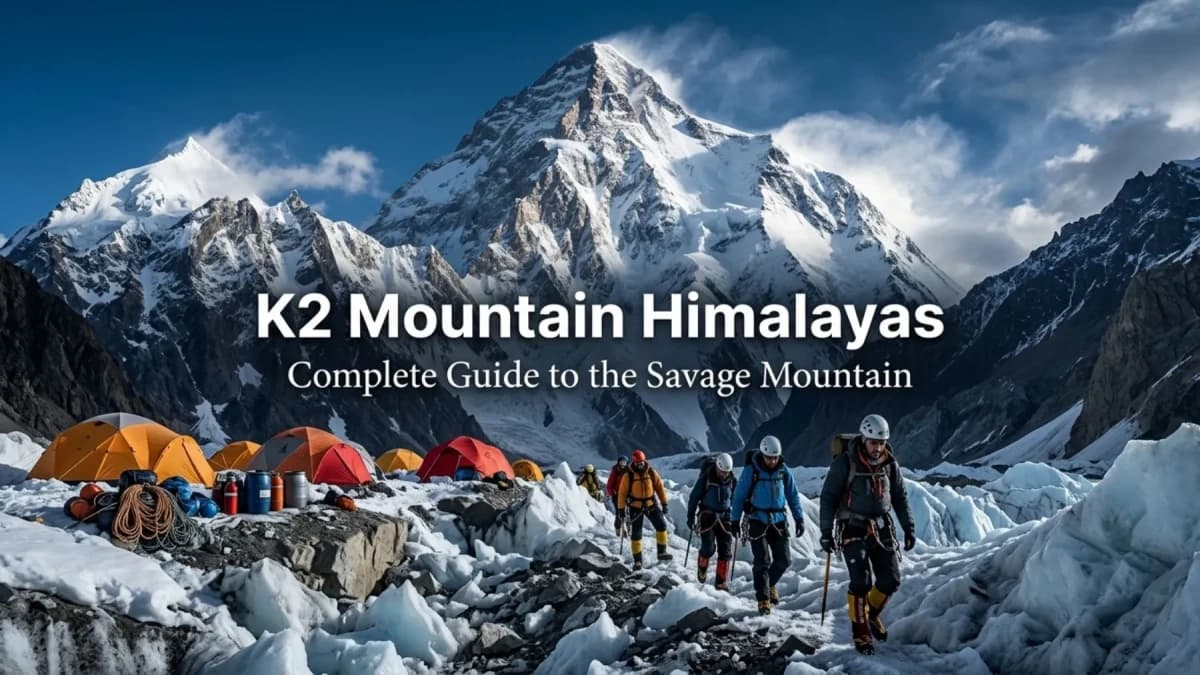
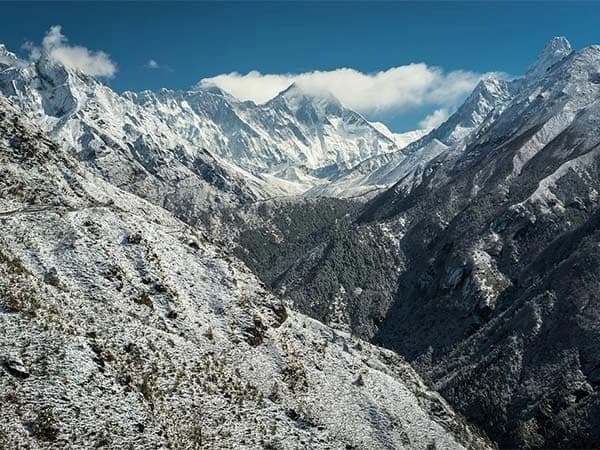
Known as “The Savage Mountain,” K2 is considered the world’s most dangerous and technically difficult 8,000-meter peak because of its steep terrain, unpredictable storms, avalanche danger, and extreme altitude. The nickname became famous after American climber George Bell described it in 1953 as “a savage mountain that tries to kill you.” Historically, the mountain has recorded a fatality rate of around 23–25%, far higher than Everest.
K2 was first surveyed in 1856 and successfully climbed for the first time in 1954 by Italian mountaineers Lino Lacedelli and Achille Compagnoni via the famous Abruzzi Spur route. As of 2023, only around 800 climbers had reached the summit, while 96 deaths had been recorded on the mountain.
Quick Facts About K2 Mountain
| Feature |
Details |
| Height |
8,611 meters (28,251 ft) |
| Global Rank |
2nd Highest Mountain on Earth |
| Mountain Range |
Karakoram |
| Location |
Pakistan–China Border |
| Region |
Gilgit-Baltistan & Xinjiang |
| Nearby Glacier |
Baltoro Glacier |
| Nickname |
The Savage Mountain |
| First Ascent |
1954 |
| Deadliness |
One of the world’s deadliest peaks |
| Famous Route |
Abruzzi Spur |
| Total Summits (2023) |
~800 |
| Recorded Deaths |
96 |
Where Is K2 Mountain Himalayas Located?
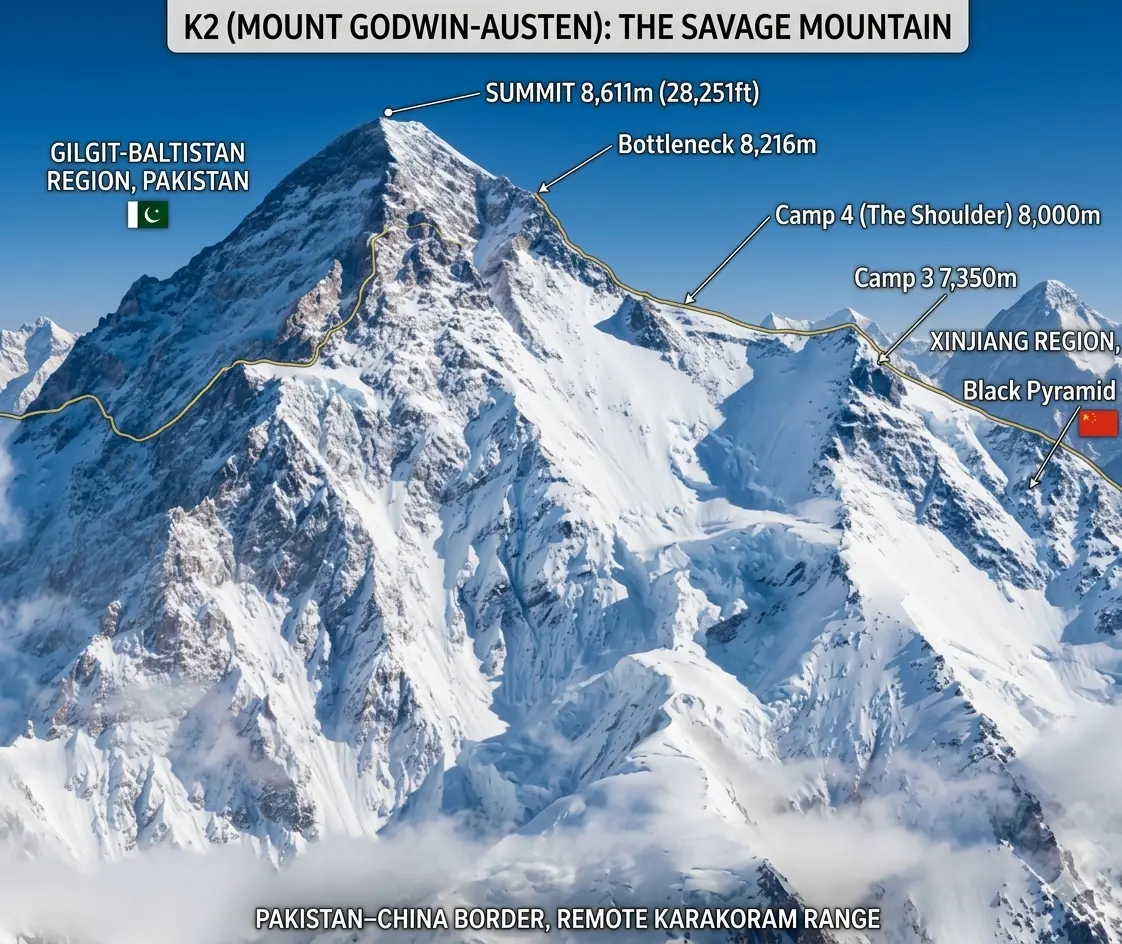
K2 is located on the Pakistan–China border in the remote Karakoram Range, between Pakistan’s Gilgit-Baltistan region and China’s Xinjiang region. The mountain rises above the famous Baltoro Glacier near the Godwin Austen Glacier inside the Central Karakoram National Park.
Although many people think K2 is in the Himalayas, this is technically incorrect. K2 belongs to the Karakoram Range, a separate mountain system known for its steeper terrain, harsher landscapes, and higher glacier density. The confusion happens because both the Karakoram and Himalayas are part of the greater high-mountain region of South and Central Asia.
Karakoram vs Himalayas
| Feature |
Karakoram |
Himalayas |
| Location |
Pakistan / China |
Nepal / India / Bhutan |
| Highest Peak |
K2 (8,611m) |
Everest (8,849m) |
| Terrain |
More rugged |
Broader range |
| Glacier Density |
Higher |
Lower |
Why Is K2 Called the Savage Mountain?
K2 is known as “The Savage Mountain” because of its extreme technical difficulty, deadly weather, steep climbing terrain, and high fatality rate. The nickname became famous in 1953 when American climber George Bell described K2 as “a savage mountain that tries to kill you” after surviving a near-fatal expedition.
Unlike Everest, K2 has no easy climbing sections. Most routes involve steep 40–60° ice and rock climbing, sudden storms, avalanche danger, and extreme isolation with limited rescue options. Historically, K2’s fatality rate has been around 23–25%, making it far deadlier than Everest. Above 8,000 meters, climbers enter the “Death Zone,” where oxygen levels drop to about one-third of sea level, causing exhaustion, confusion, hallucinations, and life-threatening altitude sickness.
What Makes K2 So Feared?
| Danger Factor |
Why It’s Dangerous |
| Bottleneck |
Serac collapse danger |
| Weather |
Sudden violent storms |
| Steepness |
Continuous technical climbing |
| Isolation |
Very limited rescue options |
| Death Zone |
Extreme oxygen deprivation |
Recommended for you: Where Is Mount Everest Located in Asia?
K2 vs Everest: Which Mountain Is Harder?
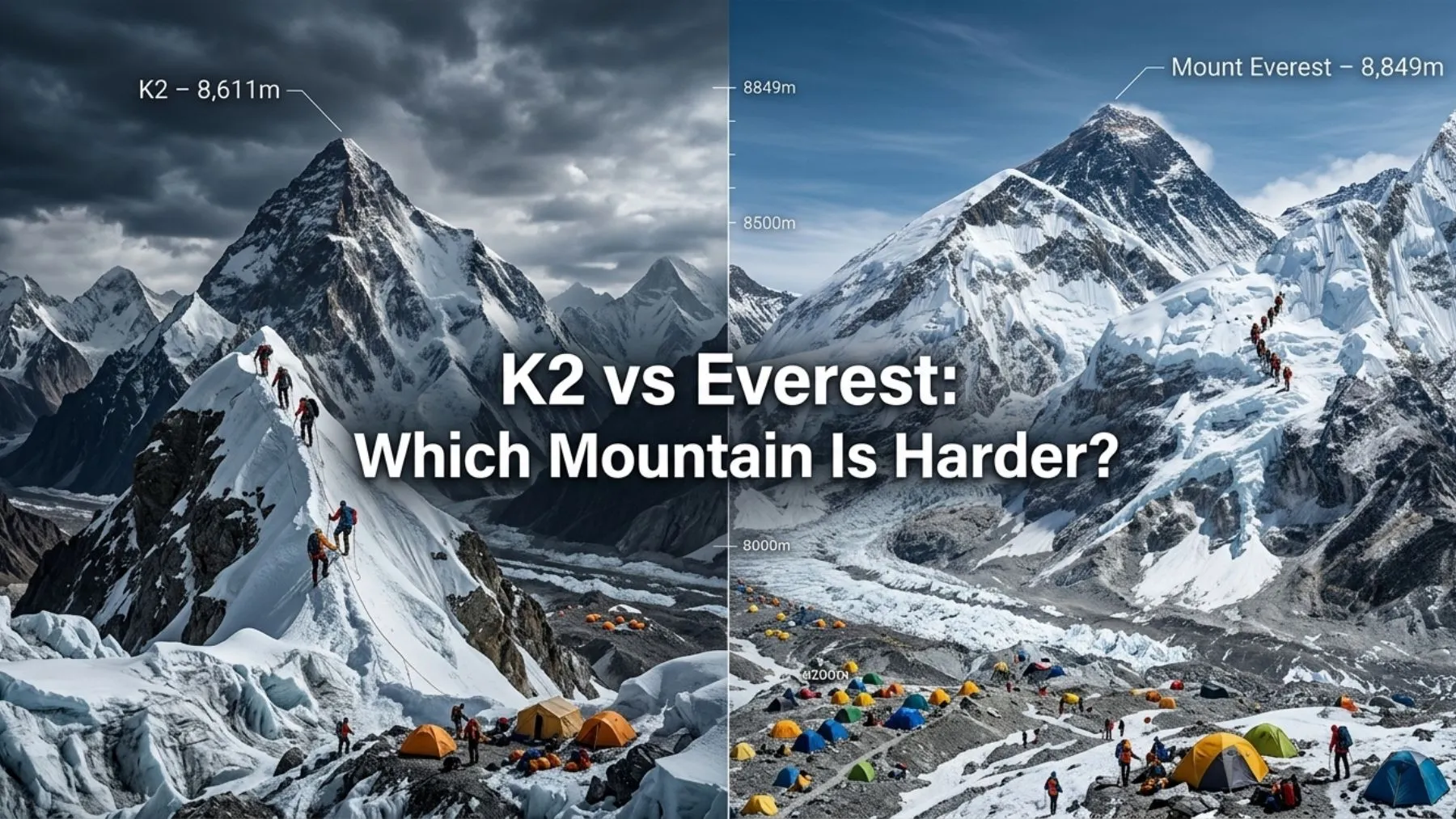
Although Mount Everest (8,849m) is higher than K2 (8,611m), most mountaineers consider K2 significantly harder and more dangerous because of its steep technical climbing, harsher weather, avalanche risk, and limited rescue infrastructure. Everest is physically extreme due to its altitude, but K2 demands much greater technical skill and experience.
K2 vs Everest Comparison
| Feature |
K2 |
Everest |
| 🏔️ Height |
8,611m |
8,849m |
| ⚠️ Difficulty |
Extreme |
Moderate–Extreme |
| 🧗 Technicality |
Very high |
Lower |
| ☠️ Fatality Rate |
Higher |
Lower |
| 🏕️ Commercialization |
Minimal |
Heavy |
| 🚁 Rescue Infrastructure |
Limited |
Better |
| 👥 Crowds |
Rare |
Common |
Why K2 Is Harder Than Everest?
K2 has steeper slopes, more technical rock and ice climbing, unpredictable storms, and dangerous sections like the Bottleneck, where climbers face hanging seracs and avalanche risk. Historically, K2’s fatality rate has been far higher than Everest’s.
Why Everest Is Still Extremely Dangerous?
Despite having better infrastructure and fixed ropes, Everest remains extremely dangerous because of its altitude, overcrowding, avalanches, crevasses, and the severe oxygen deprivation above 8,000 meters in the Death Zone.
Which Mountain Requires More Skill?
Everest requires strong endurance and high-altitude experience, but K2 demands advanced technical mountaineering skills, ice climbing ability, and rapid decision-making in extreme conditions, which is why it is often considered the tougher mountain to climb.
Read this next: Annapurna Base Camp vs Everest Base Camp Trek
The Geography of K2 & the Karakoram Range
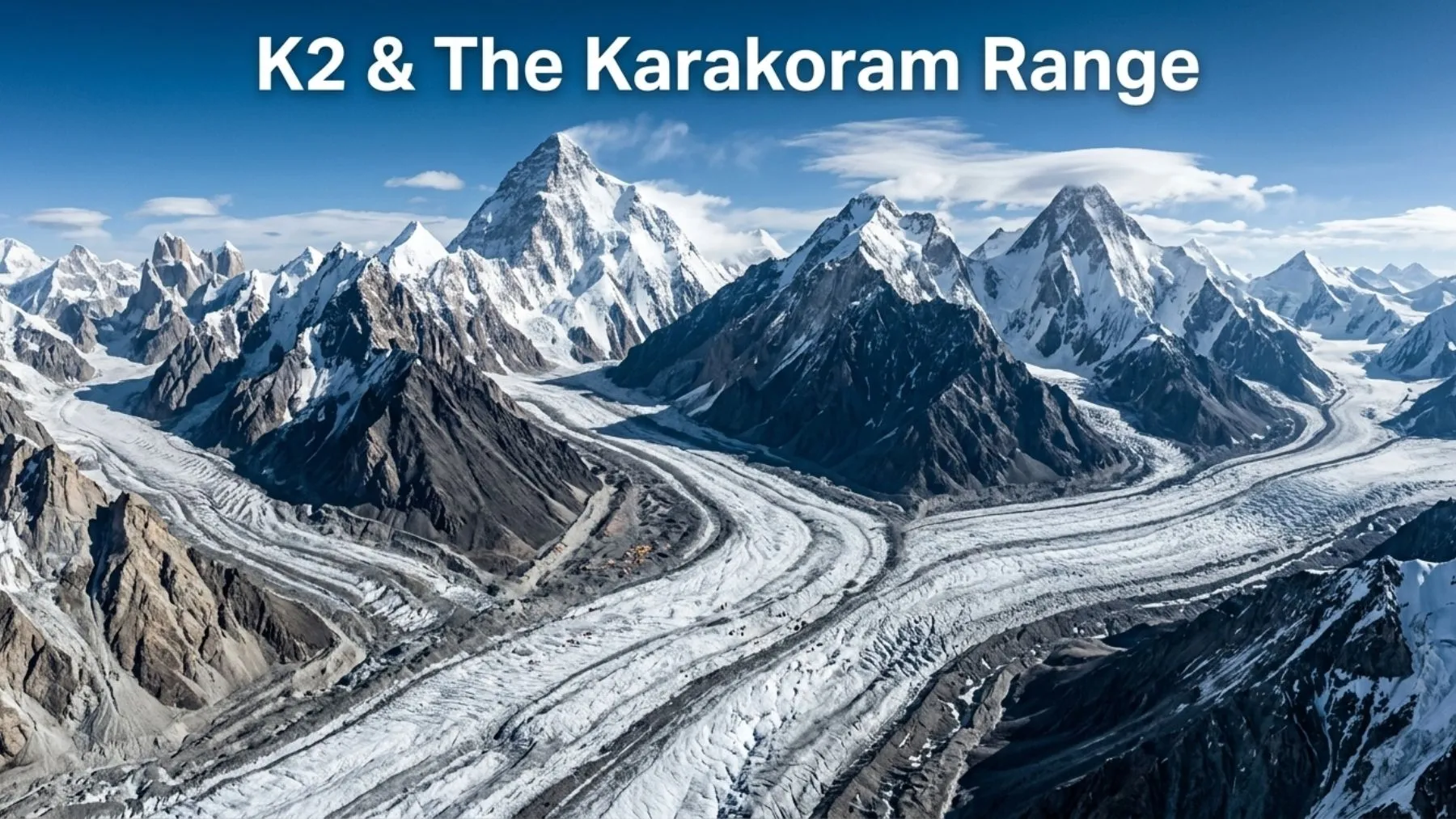
K2 rises within the rugged Karakoram Range, a high mountain system formed by the collision of the Indian and Eurasian tectonic plates millions of years ago. The region is known for its steep granite peaks, deep valleys, and one of the world’s highest concentrations of glaciers outside the polar regions.
One of the most important glaciers near K2 is the Baltoro Glacier, which stretches for about 63 km (39 miles) and serves as the main trekking route toward K2 Base Camp. Near the upper Baltoro lies Concordia, a famous glacier junction often called “The Throne Room of the Mountain Gods” because of the massive peaks surrounding it.
Concordia offers views of some of the world’s most iconic mountains, including K2, Broad Peak (8,051m), Gasherbrum I (8,080m), and Gasherbrum II (8,035m). The area is considered one of the most dramatic mountain landscapes on Earth because of its concentration of towering 8,000-meter peaks, glaciers, and remote wilderness.
You may also like: Truth About Dead Bodies on Mount Everest
Major Climbing Routes on K2
K2 has several climbing routes, but all are considered extremely dangerous because of steep rock faces, unstable ice, avalanche risk, and severe weather. Unlike Everest, there are no “easy” routes on K2, and every path requires advanced technical mountaineering skills.
1. Abruzzi Spur (Most Famous Route)
The Abruzzi Spur is the standard and most climbed route on K2, first attempted by the Duke of Abruzzi expedition in 1909. It passes through dangerous sections such as House’s Chimney, the Black Pyramid, the Shoulder, and the Bottleneck, making it highly technical despite being the most popular route.
2. Česen Route
The Česen Route, also called the Basque Route, climbs the south-southeast face and is known for steep snow and ice sections. It is sometimes used as an alternative to avoid parts of the Abruzzi Spur.
3. North Ridge
The North Ridge approaches K2 from the Chinese side through Xinjiang and involves colder conditions, high winds, and logistical difficulties due to the mountain’s remote northern terrain.
4. Magic Line
The Magic Line is considered one of the hardest and most dangerous routes on K2 because of its extremely steep climbing and exposure. Legendary climber Reinhold Messner once described it as “suicidal” because of the objective risks involved.
Also read: Why is Annapurna 3 Unclimbed?
Route Difficulty Comparison
| Route |
Difficulty |
Popularity |
Risk Level |
| Abruzzi Spur |
Very High |
Most climbed |
Extreme |
| Magic Line |
Elite |
Rare |
Severe |
| Česen Route |
Extremely High |
Less common |
Very High |
| North Ridge |
Extremely High |
Rare |
Severe |
The Bottleneck: K2’s Most Dangerous Section
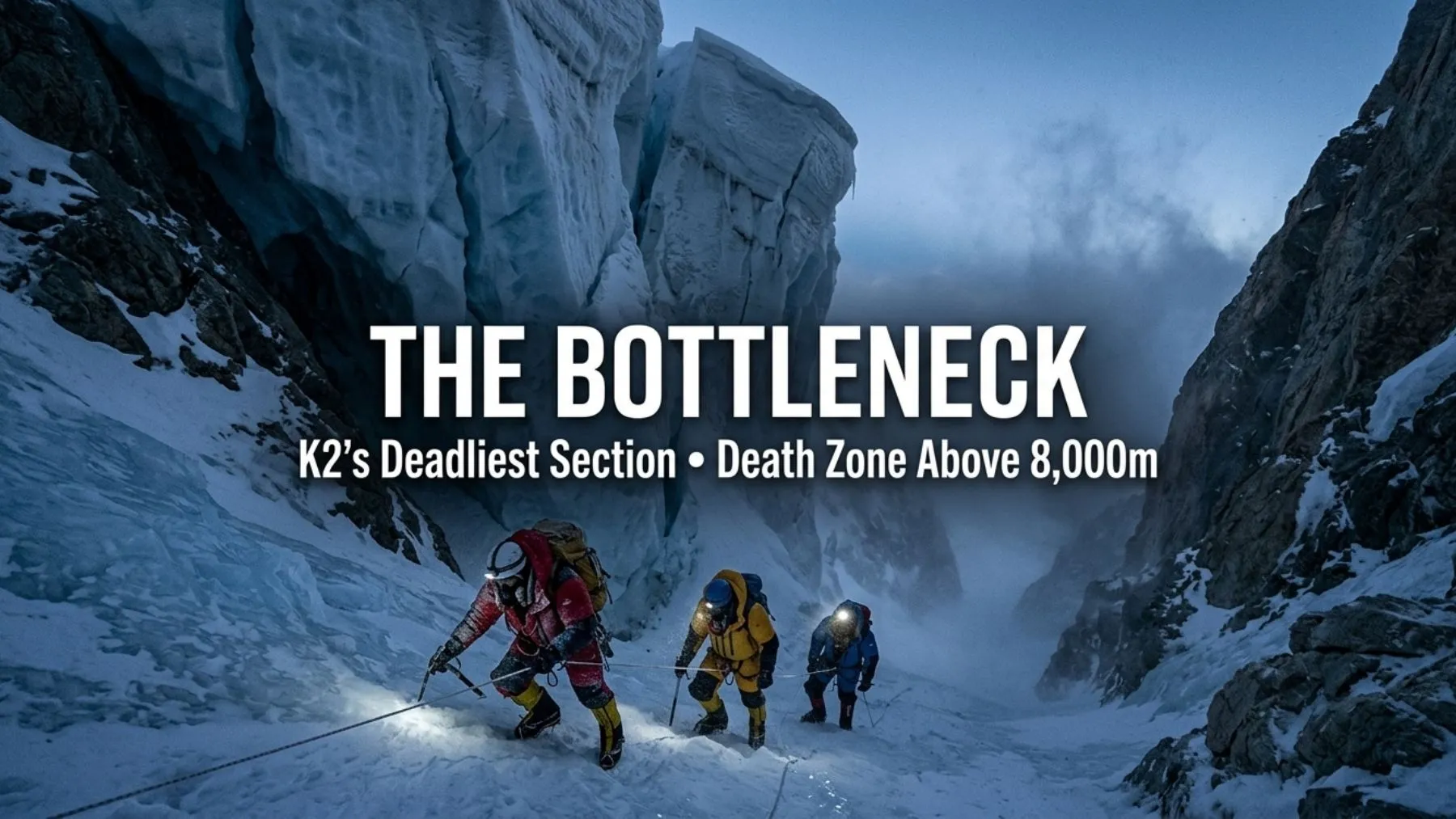
The Bottleneck is considered the deadliest part of K2 and is located at around 8,200 meters just below the summit. This narrow and steep couloir forces climbers to pass directly beneath massive hanging ice seracs that can collapse without warning. The section often becomes extremely dangerous during summit pushes because of climber traffic, exhaustion, darkness, and exposure to avalanches and falling ice.
Many of K2’s historic disasters, including the tragic 2008 accident, were linked to the Bottleneck after collapsing seracs destroyed fixed ropes and trapped climbers high on the mountain.
What Is the Death Zone?
The Death Zone refers to altitudes above 8,000 meters, where oxygen levels drop to roughly one-third of sea level pressure. At this height, the human body slowly begins to shut down because it cannot properly acclimatize. Climbers face severe risks such as HACE (High Altitude Cerebral Edema), HAPE (High Altitude Pulmonary Edema), hallucinations, confusion, dehydration, and decision fatigue.
What Climbers Experience Above 8,000m?
Above 8,000 meters, even simple actions like walking, clipping ropes, or melting snow become exhausting. Climbers often experience extreme fatigue, slowed thinking, memory problems, frostbite risk, and severe breathing difficulty because every movement feels like exercising with very little oxygen.
Learn more: Is Annapurna Part of Everest?
How the Human Body Reacts on K2 Mountain Himalayas?
Climbing K2 places the human body under extreme physical and mental stress because of severe oxygen deprivation, freezing temperatures, and prolonged exhaustion. Above 8,000 meters, climbers receive only about one-third of the oxygen available at sea level, causing rapid fatigue, slower thinking, dehydration, muscle loss, and severe breathing difficulty.
K2 climbers also face high risks of frostbite, sleep deprivation, calorie burn, mental exhaustion, HACE, and HAPE, especially during long summit pushes in temperatures that can drop below −40°C. Even basic movements become physically draining at extreme altitude.
Altitude Effects on the Human Body
| Altitude |
Effect on Human Body |
| 3,000m |
Mild altitude symptoms |
| 5,000m |
Reduced oxygen efficiency |
| 8,000m+ |
Extreme survival zone |
History of K2 Expeditions
K2 was first surveyed in 1856 during the Great Trigonometrical Survey of India and received the name “K2,” with “K” referring to the Karakoram range. In 1909, the Duke of Abruzzi led one of the earliest major expeditions and explored the famous Abruzzi Spur, which later became the standard climbing route.
The mountain was first successfully climbed on 31 July 1954 by Italian climbers Lino Lacedelli and Achille Compagnoni. K2 later became known for several deadly accidents, especially the 1986 “Black Summer”, when multiple climbers died during severe storms and altitude-related incidents. In 2021, a team of Nepali climbers achieved the historic first winter ascent of K2, one of modern mountaineering’s greatest milestones.
K2 Expedition Timeline
| Year |
Milestone |
| 1856 |
K2 surveyed |
| 1954 |
First successful ascent |
| 1986 |
Black Summer disasters |
| 2021 |
First winter ascent |
Legendary Climbers of K2 Himalayan Peak
Many legendary mountaineers have shaped K2’s history through extraordinary climbs, survival stories, and bold expedition styles. Reinhold Messner became famous for his alpine-style climbing philosophy and described K2’s Magic Line as nearly suicidal because of its extreme risks.
Nepali climber Nims Purja played a major role in the historic 2021 winter ascent, highlighting teamwork and modern high-altitude climbing leadership. Polish climber Wanda Rutkiewicz became one of the first women to summit K2 in 1986, while Austrian climber Gerlinde Kaltenbrunner later became the first woman to climb all 14 eight-thousanders without supplemental oxygen, including K2.
Worth reading: Top 10 Reasons to Visit Upper Mustang in Nepal
K2 Base Camp Trek: Journey Into the Karakoram
The K2 Base Camp Trek is one of the world’s most remote and dramatic trekking adventures, taking travelers deep into the Karakoram Range through massive glaciers and high-altitude wilderness. The journey usually begins in Islamabad, followed by a flight to Skardu and a long drive to Askole, the final village before entering the Baltoro region.
From Askole, trekkers follow the legendary Baltoro Glacier toward Concordia, a spectacular glacier junction often called the “Throne Room of the Mountain Gods,” surrounded by peaks such as K2, Broad Peak, and the Gasherbrums. The full trek generally takes around 12–16 days depending on the itinerary and weather conditions.
What It Feels Like Trekking to K2 Base Camp
Trekking to K2 Base Camp feels raw, isolated, and far more remote than most Himalayan treks. Unlike Everest Base Camp, there are very few settlements, limited communication, and almost no modern infrastructure, creating a true wilderness experience.
Best Time for K2 Base Camp Trek
The best trekking season is usually from June to August, when weather conditions are relatively stable and the Baltoro Glacier route is more accessible.
Trek Difficulty & Logistics
The trek is physically demanding because of long walking days, glacier crossings, rocky terrain, and high altitude. Most expeditions require camping support, guides, porters, and careful acclimatization.
K2 Base Camp Trek vs Everest Base Camp Trek
| Feature |
K2 Base Camp |
Everest Base Camp |
| Crowds |
Very low |
Very high |
| Wilderness |
Extreme |
Moderate |
| Infrastructure |
Basic |
Developed |
| Isolation |
Very high |
Moderate |
Don't miss: 15 Amazing Things to do in Nepal
K2 Mountain Weather & Climate Conditions
K2 is known for some of the harshest mountain weather on Earth, with powerful jet stream winds, sudden storms, avalanches, and extremely cold temperatures making climbing highly unpredictable. Winter temperatures on the upper mountain can drop below −50°C, while wind chill may reach around −75°C during severe storms.
Climbers usually wait for short and rare summit windows, when wind speeds temporarily decrease and weather conditions become more stable. Even during the climbing season, storms can arrive suddenly and trap climbers high on the mountain for days.
Explore Himalayan Treks with Recreation Holidays
While Recreation Holidays does not currently operate K2 expeditions or K2 Base Camp treks, we offer a wide range of unforgettable Himalayan adventures across Nepal. Our popular trekking experiences include the Everest Base Camp Trek, Luxury Everest Base Camp Trek, Everest Three Passes Trek, Gokyo Lake Trek, Annapurna Base Camp Trek, Mardi Himal Trek,Annapurna Circuit Trek, Poon Hill Trek, Langtang Valley Trek, Gosainkunda Trek, Manaslu Circuit Trek, Tsum Valley Trek, and Makalu Base Camp Trek.
Whether you want Everest views, remote mountain valleys, high Himalayan passes, or cultural trekking experiences, Recreation Holidays provides professionally guided trekking adventures throughout Nepal’s most iconic trekking regions.
Conclusion
K2 mountain Himalayas is far more than just the world’s second-highest mountain. Rising to 8,611 meters (28,251 ft) in the rugged Karakoram Range, it represents one of the greatest challenges in mountaineering because of its technical difficulty, extreme weather, deadly Bottleneck section, and harsh high-altitude environment.
From the glaciers of Baltoro and Concordia to the legendary climbing routes and survival stories of elite mountaineers, K2 continues to symbolize human endurance, fear, ambition, and exploration. Whether viewed as the “Savage Mountain,” a mountaineering dream, or one of Earth’s last true wilderness regions, K2 remains one of the most fascinating mountains on the planet.
Related Blogs You May Like
Who Cleans Mount Everest's Garbage?
When is The Best Time to Visit Nepal?
Top 10 Best Winter Treks in Nepal
MICE Tourism in Nepal
7 Best Casinos in Kathmandu
FAQs About K2 Mountain Himalayas
What Is the Height of K2 Mountain?
K2 stands at 8,611 meters (28,251 feet) above sea level, making it the second-highest mountain in the world after Mount Everest.
Why Mount K2 Is Called K2?
The name “K2” was given during the Great Trigonometrical Survey of India in 1856, where “K” stood for the Karakoram Range and “2” marked it as the second surveyed peak in the region.
Where Is K2 Located?
K2 is located on the Pakistan–China border in the Karakoram Range, between Pakistan’s Gilgit-Baltistan region and China’s Xinjiang region.
What Is the Death Rate of K2?
Historically, K2 had a fatality rate of around 23–25%, making it one of the world’s deadliest 8,000-meter mountains. Modern climbing technology and weather forecasting have slightly reduced the risk in recent years.
Why Is K2 Called the Savage Mountain?
K2 is called the “Savage Mountain” because of its extreme technical difficulty, steep terrain, severe storms, avalanche danger, and high fatality rate. The nickname became famous after climber George Bell described it in 1953.
What Is the K2 Bottleneck?
The Bottleneck is a narrow and dangerous section near 8,200 meters below K2’s summit, known for hanging ice seracs, avalanche risk, and climber exposure inside the Death Zone.
Who Was the First Woman to Climb K2?
Polish climber Wanda Rutkiewicz became the first woman to successfully summit K2 in 1986.
K2 vs Mount Everest: Which Is Harder?
Although Everest is taller at 8,849 meters, most mountaineers consider K2 more difficult because of its technical climbing, steeper terrain, harsher weather, and limited rescue infrastructure.