
Nepal is a landlocked country in South Asia situated between India to the south, east, and west and China's Tibet Autonomous Region to the north. Covering an area of 147,516 km², Nepal lies in the heart of the Himalayas and is home to Mount Everest (8,848.86 m), the highest mountain on Earth. Despite its relatively small size, the country contains eight of the world's fourteen peaks above 8,000 meters, making it one of the most geographically remarkable destinations on the planet.
Where Is Nepal Located in Asia?

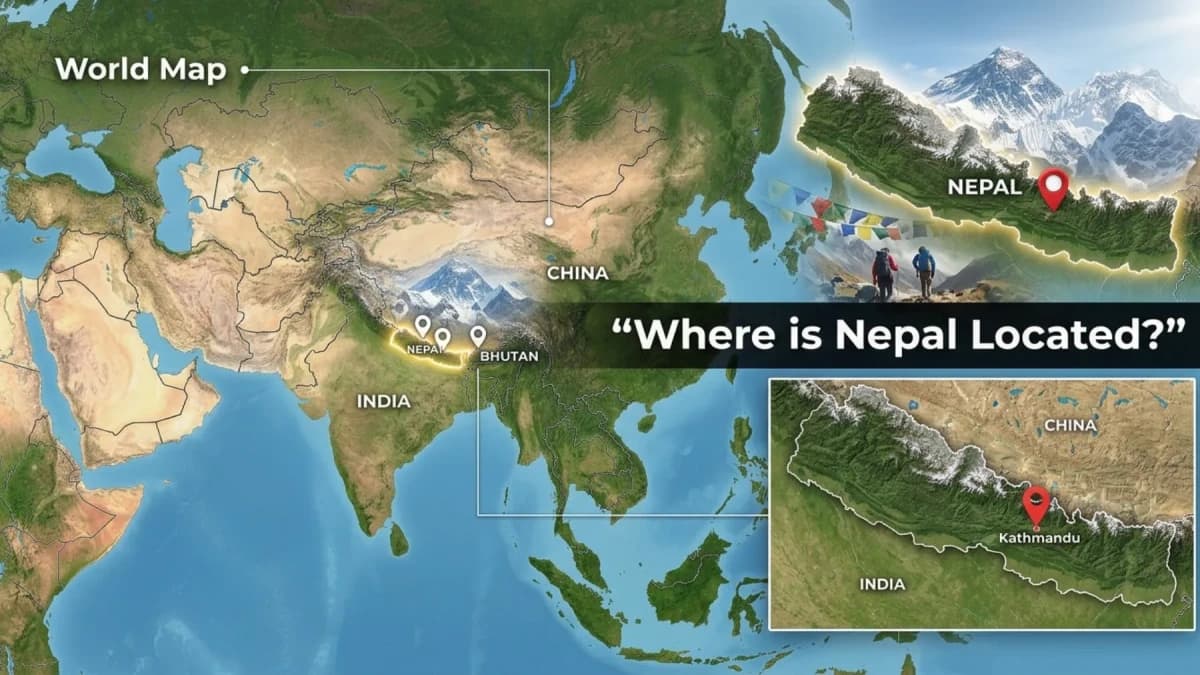
Nepal's location between two of Asia's largest nations has shaped its history, culture, and identity for centuries. From the snow-covered summits of the Himalayan Region to the fertile plains of the Terai, the country offers extraordinary geographic diversity within a relatively compact area. This dramatic landscape supports rich biodiversity, ancient traditions, and some of South Asia's most important cultural and religious landmarks.
Today, Nepal attracts travelers from around the world for its legendary trekking routes, sacred pilgrimage sites, diverse wildlife, and vibrant mountain culture. Whether you are exploring Kathmandu's heritage monuments, trekking through the Everest or Annapurna regions, or visiting the birthplace of Buddha in Lumbini, Nepal offers an experience unlike anywhere else in the world.
Nepal at a Glance (Quick Facts)
If you're wondering where Nepal is located in Asia, the country lies in South Asia, between India and China's Tibet Autonomous Region. Despite covering just 147,516 km², Nepal is home to the world's highest mountain, extraordinary cultural heritage, and remarkable geographic diversity.
| Fact | Details |
|---|---|
| Official Name | Federal Democratic Republic of Nepal |
| Continent | Asia |
| Region | South Asia |
| Capital City | Kathmandu |
| Area | 147,516 km² |
| Population | 30+ Million |
| Currency | Nepalese Rupee (NPR) |
| Time Zone | Nepal Standard Time (UTC +5:45) |
| Highest Mountain | Mount Everest (8,848.86 m) |
| Neighboring Countries | India and China |
| Official Language | Nepali |
From the subtropical plains of the Terai to the peaks of the Himalayas, Nepal offers one of the world's greatest elevation ranges—from just 59 m above sea level to 8,848.86 m at the summit of Mount Everest. This extraordinary geography has shaped Nepal's culture, biodiversity, and global reputation as a premier destination for trekking, adventure, and spiritual travel.
Where Is Nepal Located in the World?
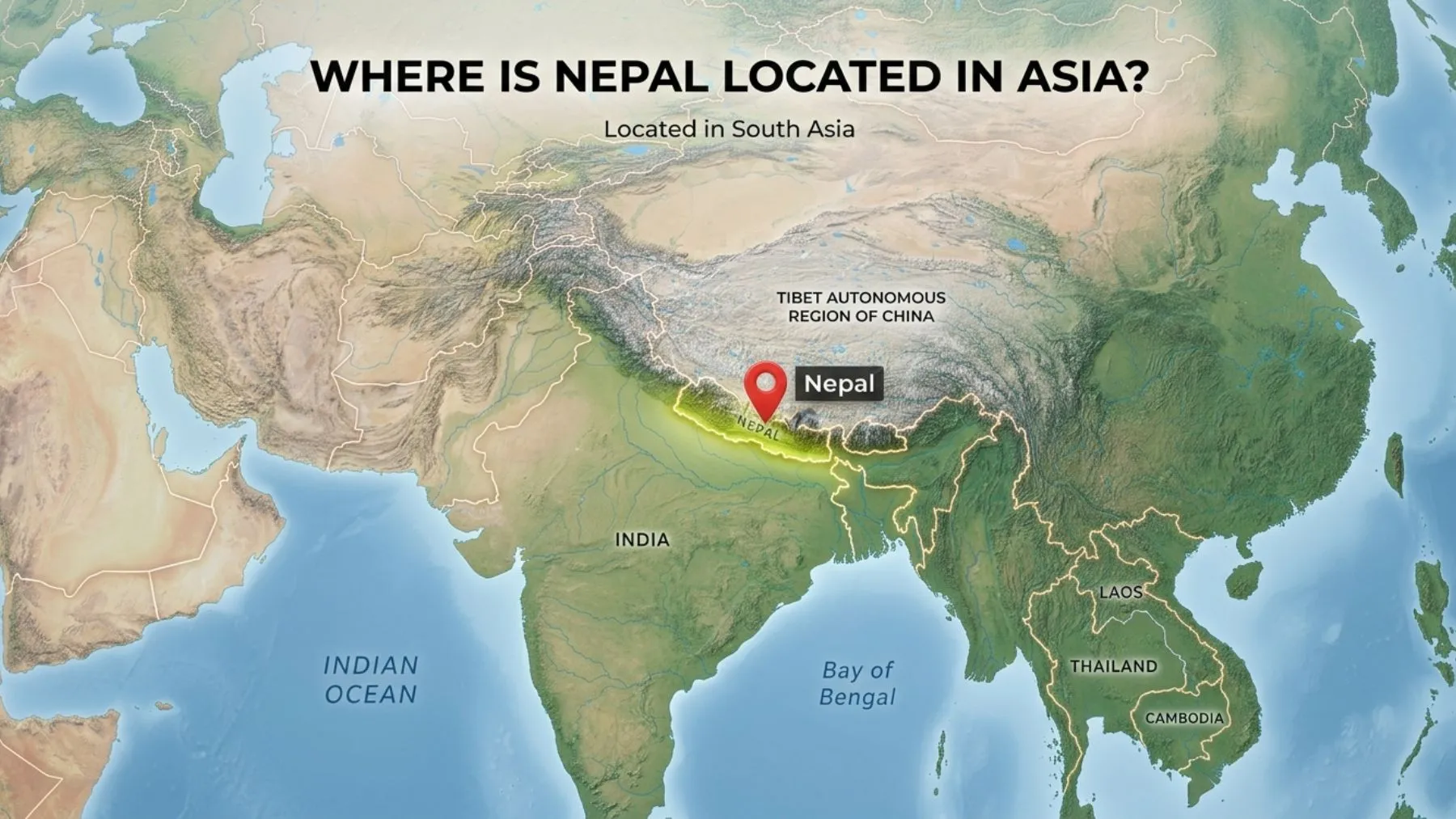
Nepal is located in the Northern Hemisphere on the Asian continent, within the South Asian region. It sits along the central Himalayan belt, between India to the south, east, and west and China's Tibet Autonomous Region to the north. This strategic position places Nepal at the crossroads of some of Asia's most significant geographic and cultural landscapes.
The country's approximate geographic coordinates are 28°00′N latitude and 84°00′E longitude, extending from 26°22′N–30°27′N and 80°04′E–88°12′E. Despite its modest size, Nepal contains some of the world's highest mountains, including Mount Everest, making it one of the most geographically distinctive countries on Earth.
Where Is Nepal Located in Asia?
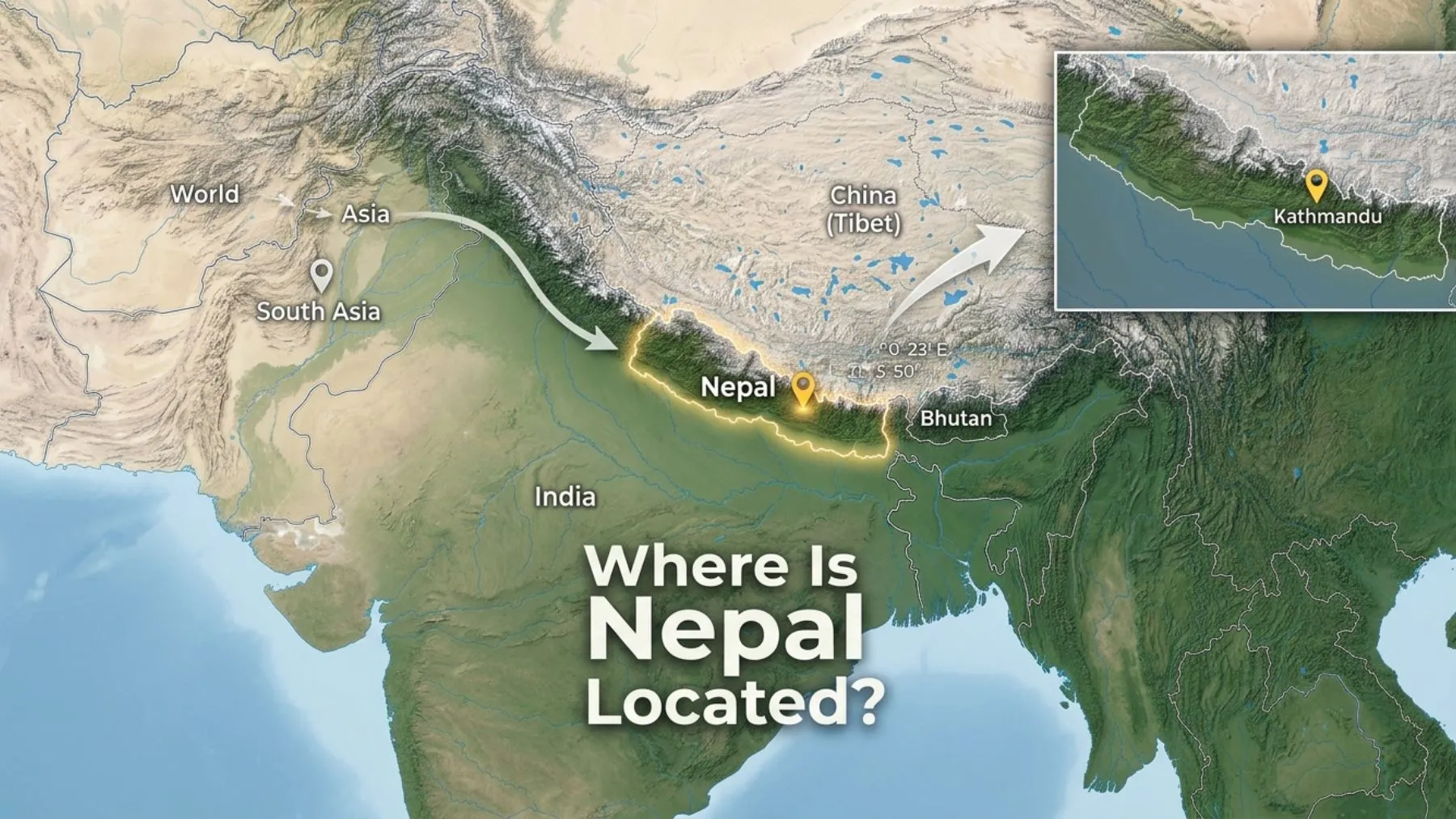
Nepal is a South Asian country located between India and China's Tibet Autonomous Region, forming part of the Himalayan corridor that connects the Indian subcontinent with the Tibetan Plateau. Its strategic position has influenced regional trade, culture, religion, and mountain exploration for centuries. Although landlocked, Nepal occupies one of the most important geographic locations in the Himalayas and is home to eight of the world's fourteen peaks above 8,000 meters.
Learn more: 15 Amazing Things to do in Nepal
South Asia Comparison
| Country | Region |
|---|---|
| Nepal | South Asia |
| India | South Asia |
| Bhutan | South Asia |
| Bangladesh | South Asia |
| Pakistan | South Asia |
| Sri Lanka | South Asia |
Together, these countries form the core of South Asia, a region known for its cultural diversity, historical significance, and rapidly growing economies.
Also read: K2 Mountain Himalayas - Complete Guide
Which Countries Border Nepal?
Nepal shares international borders with only two countries. To the north, it borders China's Tibet Autonomous Region, while India borders Nepal to the south, east, and west. These borders have played an important role in shaping Nepal's trade, culture, and strategic position within South Asia.
Nepal Border Statistics
| Border Country | Approximate Border Length |
|---|---|
| India | 1,690 km |
| China (Tibet Autonomous Region) | 1,236 km |
Nepal's total international border stretches approximately 2,926 km. Despite being a landlocked country, its location between two of the world's most populous nations gives it significant geopolitical and economic importance.
Why Nepal's Location Is Geographically Unique?
Nepal may be relatively small in size, but few countries can match its geographic diversity. Situated between India and China, Nepal occupies a strategic position in the heart of the Himalayas and serves as a historic meeting point of South Asian and Tibetan cultures.
The country is home to Mount Everest (8,848.86 m) and eight of the world's fourteen peaks above 8,000 meters, giving Nepal one of the highest concentrations of extreme-altitude mountains anywhere on Earth. Equally remarkable is its elevation range, which rises from just 59 m above sea level in the southern Terai to the summit of Everest within a distance of only a few hundred kilometers.
This dramatic terrain creates an extraordinary variety of ecosystems, climates, and landscapes—from subtropical plains and river valleys to alpine meadows, glaciers, and snow-covered peaks. Nepal is also a cultural crossroads where Hinduism and Buddhism have flourished side by side for centuries, while its protected areas support iconic wildlife such as the Bengal Tiger, One-Horned Rhinoceros, Snow Leopard, and Red Panda.
Don't miss: Truth About Dead Bodies on Mount Everest and Tragic Story of Everest's Sleeping Beauty
Why Nepal Stands Out Geographically?
| Geographic Feature | Why It Is Unique |
|---|---|
| Mount Everest | World's highest mountain (8,848.86 m) |
| Elevation Range | From 59 m to 8,848.86 m |
| Biodiversity | Multiple ecosystems from subtropical to alpine |
| Culture | Strong Hindu and Buddhist heritage |
| Geography | Combines Himalayan peaks, hills, valleys, and plains |
Know more: 7 Best Casinos in Kathmandu
Understanding Nepal's Three Major Geographic Regions
Despite covering only 147,516 km², Nepal contains three distinct geographic regions, each with its own landscape, climate, culture, and attractions. Together, they create one of the world's greatest ranges of elevation and biodiversity.
1. The Himalayan Region
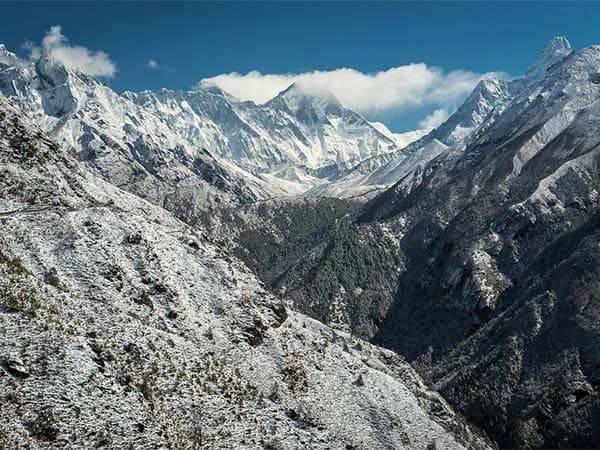
Occupying the northern part of the country, the Himalayan Region ranges from roughly 4,000 m to 8,848.86 m and features an alpine climate, glaciers, and some of the world's highest mountains, including Everest, Annapurna, and Manaslu. It is also Nepal's premier trekking area.
2. The Mid-Hills Region
The Mid-Hills stretch across central Nepal at elevations of approximately 600–4,000 m. This temperate zone includes the Kathmandu Valley, Pokhara Valley, traditional villages, terraced farmland, and many of Nepal's largest settlements.
3. The Terai Region
Located along Nepal's southern border, the Terai lies between 59 m and 600 m above sea level. This subtropical lowland is the country's agricultural heartland and home to major wildlife habitats, national parks, Chitwan, and Lumbini, the birthplace of Buddha.
Find out more: Top 10 UNESCO World Heritage Sites in Nepal
Comparison of Nepal's Geographic Regions
| Region | Elevation | Climate | Key Attractions |
|---|---|---|---|
| Himalayas | High (4,000–8,848.86 m) | Alpine | Everest, Annapurna, Manaslu |
| Mid Hills | Moderate (600–4,000 m) | Temperate | Kathmandu, Pokhara |
| Terai | Low (59–600 m) | Subtropical | Chitwan, Lumbini |
Also get to know: Why is Annapurna 3 Unclimbed?
Why Travelers Visit Nepal?
From the world's highest mountains to ancient cultural landmarks, Nepal offers an extraordinary mix of adventure, spirituality, wildlife, and heritage within a relatively small area. Here are some of the main reasons millions of travelers choose to visit Nepal each year.
Nepal Travel Highlights
| Reason | Why Visitors Love It |
|---|---|
| Himalayan Peaks | Home to Mount Everest (8,848.86 m) and 8 of the world's 14 peaks above 8,000 m |
| World-Class Trekking | Famous routes in the Everest, Annapurna, Langtang, and Mustang regions |
| Ancient Heritage | Historic UNESCO World Heritage Sites in Kathmandu Valley and beyond |
| Spiritual Significance | Birthplace of Lord Buddha in Lumbini and home to major Hindu and Buddhist pilgrimage sites |
| Wildlife Safaris | Rare wildlife including the Bengal Tiger and One-Horned Rhinoceros in Chitwan and Bardia |
| Vibrant Festivals | Celebrations such as Dashain, Tihar, Holi, and many regional festivals |
| Warm Hospitality | Friendly local communities and diverse cultural traditions across more than 120 ethnic groups |
| Great Value | Affordable trekking, cultural tours, wildlife experiences, and mountain adventures |
Whether you're seeking Himalayan adventures, cultural exploration, wildlife encounters, or spiritual journeys, Nepal offers one of the most diverse travel experiences in South Asia.
Explore Nepal Journeys
Discover Nepal’s Best Trekking and Tour Experiences
How to Reach Nepal?
By Air
Most international travelers arrive through Tribhuvan International Airport (Kathmandu), Nepal's primary international gateway. International flights also operate through Gautam Buddha International Airport (Bhairahawa) and Pokhara International Airport, depending on airline schedules and routes.
By Land
Nepal can also be reached through several India–Nepal border crossings, making overland travel possible from major cities in northern India.
International Connectivity
Common gateway cities for flights to Nepal include Delhi, Doha, Dubai, Bangkok, Kuala Lumpur, Singapore, and Istanbul, with connections to Kathmandu from many parts of the world.
See also: MICE Tourism in Nepal
Essential Travel Facts for First-Time Visitors
| Topic | Information |
|---|---|
| Currency | Nepalese Rupee (NPR) |
| Time Zone | UTC +5:45 |
| Language | Nepali |
| Electricity | 230V, 50Hz |
| Visa | Visa on Arrival available for most nationalities |
| Religion | Primarily Hinduism and Buddhism |
Curious About Nepal and the Himalayas?
Explore unforgettable Nepal journeys with Recreation Holidays today.
Explore Nepal AdventuresWhy Travel to Nepal with Recreation Holidays?
At Recreation Holidays, we specialize in creating unforgettable Himalayan journeys across Nepal's most iconic trekking regions. Whether you're dreaming of the legendary Everest Base Camp Trek, scenic Annapurna Base Camp Trek, panoramic Mardi Himal Trek, off-the-beaten-path Khopra Danda Trek, culturally rich Langtang Valley Trek, or the adventurous Manaslu Circuit Trek, our experienced local team ensures a safe, authentic, and well-organized experience from start to finish.
Beyond Nepal, we also operate spiritual journeys to Tibet, including the Kailash Mansarovar Yatra and Kailash Mansarovar Overland Tour, allowing travelers to visit one of the most sacred pilgrimage destinations in the world. With expert local knowledge, personalized service, and carefully crafted itineraries, Recreation Holidays helps you experience the very best of the Himalayas with confidence and comfort.
Explore other related readings
Top 10 Best Winter Treks in Nepal
Top 10 Places to Visit in Kathmandu
When is The Best Time to Visit Nepal?
Kailash Mansarovar Yatra Cost 2026-27
FAQs on Where is Nepal Location
Where Is Nepal Located in Asia?
Nepal is located in South Asia, between India to the south, east, and west and China's Tibet Autonomous Region to the north. It lies in the central Himalayan region and is home to Mount Everest, the world's highest mountain.
Is Nepal Part of India or China?
No. Nepal is an independent sovereign country and is neither part of India nor China. It shares borders with both nations but has its own government, culture, currency, and national identity.
Where Is Nepal Located on a Map?
Nepal appears in South Asia on the world map, situated between northern India and the Tibetan Plateau of China. Its approximate geographic coordinates are 28°N latitude and 84°E longitude.
In Which Continent Is Nepal Located?
Nepal is located on the continent of Asia, specifically within the South Asian subregion.
Where Is Nepal Located and What Is Its Currency?
Nepal is a landlocked country in South Asia between India and China. The official currency of Nepal is the Nepalese Rupee (NPR).
What Is the Population of Nepal?
Nepal has a population of more than 30 million people, with the majority living in the Mid-Hills and Terai regions. The capital city, Kathmandu, is the country's largest urban center
Need Help? Call Us+977 9851001069orChat with us on WhatsApp
Latest Travel Blogs
News and Events
Dashain 2026: Festival Dates, Tika Time, Rituals & Celebration Guide
Sep 24, 2026By Hari
News and Events
Rainbow Valley Everest | Death Zone of Mount Everest
Sep 17, 2026By Hari

Travel Tips
20 Best Things to Do in Pokhara, Nepal [2027 Guide]
Sep 12, 2026By Hari
Need Help? Call Us.+977 9851001069