Tiji Festival Trek at a Glance
| Trip Information |
Details |
| Duration |
12 Days |
| Tiji Festival Dates |
June 1–3, 2027 |
| Region |
Upper Mustang, Nepal |
| Festival Location |
Lo Manthang |
| Lo Manthang Elevation |
Approx. 3,840 m / 12,600 ft |
| Highest Overnight Altitude |
Based on the trekking itinerary |
| Highest Trekking Point / Pass |
Based on the trekking route |
| Trekking Hours |
Based on the daily itinerary |
| Trek Distance |
Based on the daily route |
| Accommodation |
Mountain lodges / tea houses |
| Meals |
As included in the package |
| Transportation |
Road transportation and applicable domestic flights |
| Guide |
Licensed trekking guide |
| Porter |
As arranged for the trek |
| Permits |
Upper Mustang Restricted Area Permit and applicable conservation-area permits |
| Starting Price |
Current package price ($2850 Per Single Person) |
| Best Suited To |
Travelers seeking Tiji Festival and an Upper Mustang trekking experience |
Is the Tiji Festival Trek Right for You?
The Tiji Festival Trek Nepal is suitable for travelers who want to experience all three days of Tiji Festival while making the journey through Upper Mustang part of the adventure. It is particularly suited to travelers who have enough time for the full itinerary, are comfortable with high-altitude travel, and want to experience Upper Mustang beyond Lo Manthang itself.
This Trek Is Suitable If You:
- Want to attend all three days of Tiji Festival.
- Want to experience the Upper Mustang journey, not only the festival.
- Are comfortable traveling and walking at high altitude.
- Have sufficient time for the 12-day itinerary.
- Want to explore villages, landscapes and cultural sites beyond Lo Manthang.
- Want to combine trekking with a major Himalayan cultural festival.
Consider a Different Tiji Trip If You:
A Jeep-based Tiji Festival tour may be more suitable if your primary goal is to attend the festival while minimizing walking and trekking time. The Tiji Festival Trek is better aligned with travelers who want the journey through Upper Mustang to be an important part of their overall experience.
Choose a Jeep-Based Tiji Trip Instead If...
The choice between a Tiji Festival Trek and a Jeep-based Tiji Festival tour depends on how much walking, travel time and physical involvement you want from the journey.
| If your priority is... |
Consider |
| Maximum trekking experience |
Tiji Festival Trek |
| Minimum walking |
Tiji Festival Jeep Tour |
| Festival is the only priority |
Festival-focused itinerary |
| Broader Upper Mustang experience |
Longer trek |
| Limited vacation time |
Short/express option, if offered |
This distinction matters because Upper Mustang can be experienced through substantially different itineraries. A road-based journey can reach Kagbeni, Charang and Lo Manthang more quickly, while a genuine walking itinerary requires additional trekking days and a different altitude progression. The supplied itinerary currently lists road transfers on the approach to Lo Manthang, so walking distances and trekking-day specifications should only be published once they correspond to the actual walking route being sold.
What Makes the Tiji Festival Trek Different?
The Tiji Festival Trek Lo Manthang combines the three-day Tiji Festival with a journey through Upper Mustang, allowing travelers to experience the destination around the festival rather than arriving only for a single ceremony. Tiji Festival 2027 is scheduled for June 1–3, 2027, in Lo Manthang, at approximately 3,840 m (12,600 ft).
The Festival Is the Centerpiece
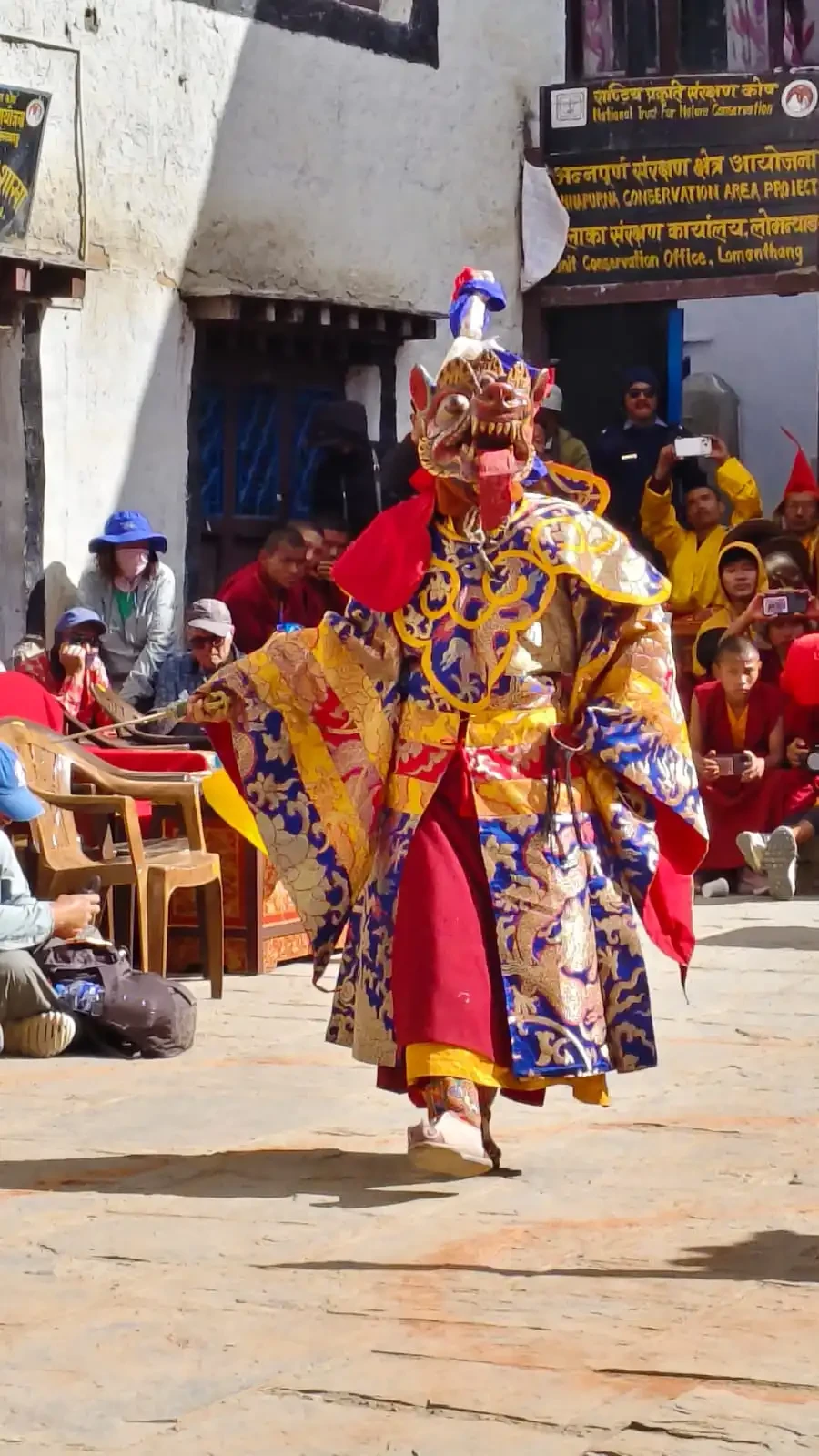
The Tiji Festival is the defining cultural event of this Upper Mustang Tiji Festival Trek. The festival takes place over three days in Lo Manthang and is traditionally associated with the annual Tiji/Tenchi celebration.
For travelers, the important distinction is that the festival is not simply a short stop within the itinerary. The journey is planned around being in Lo Manthang during the three festival days, giving travelers time to experience the ceremonies and the town's cultural environment.
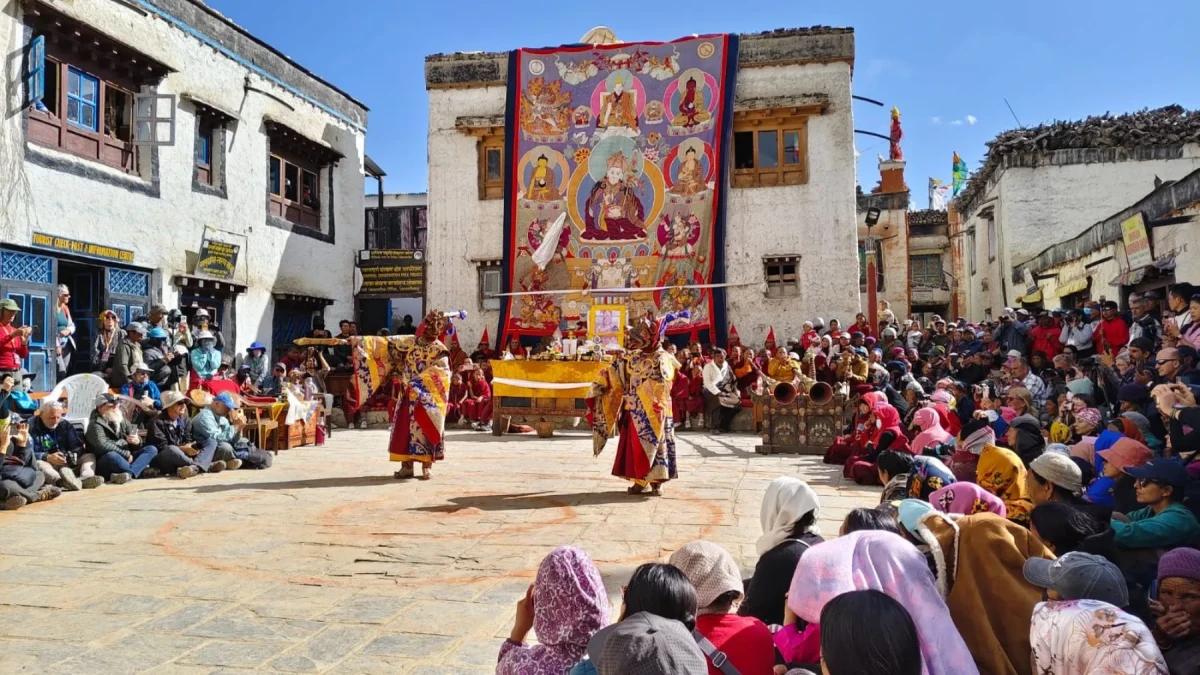
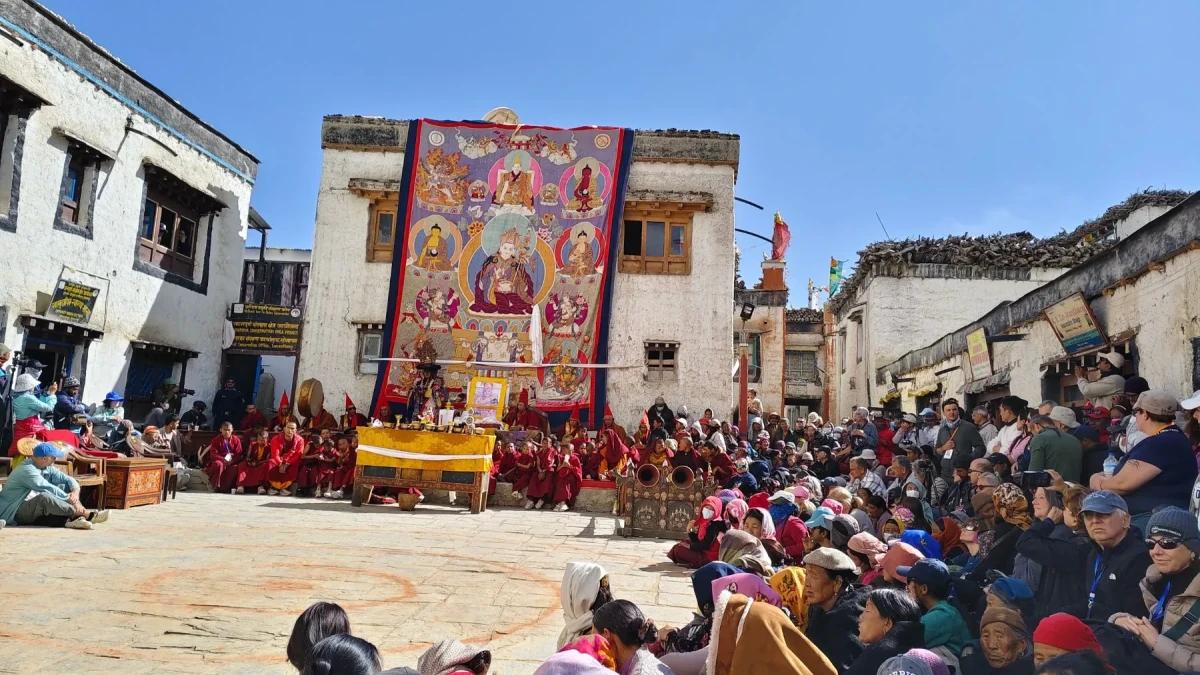
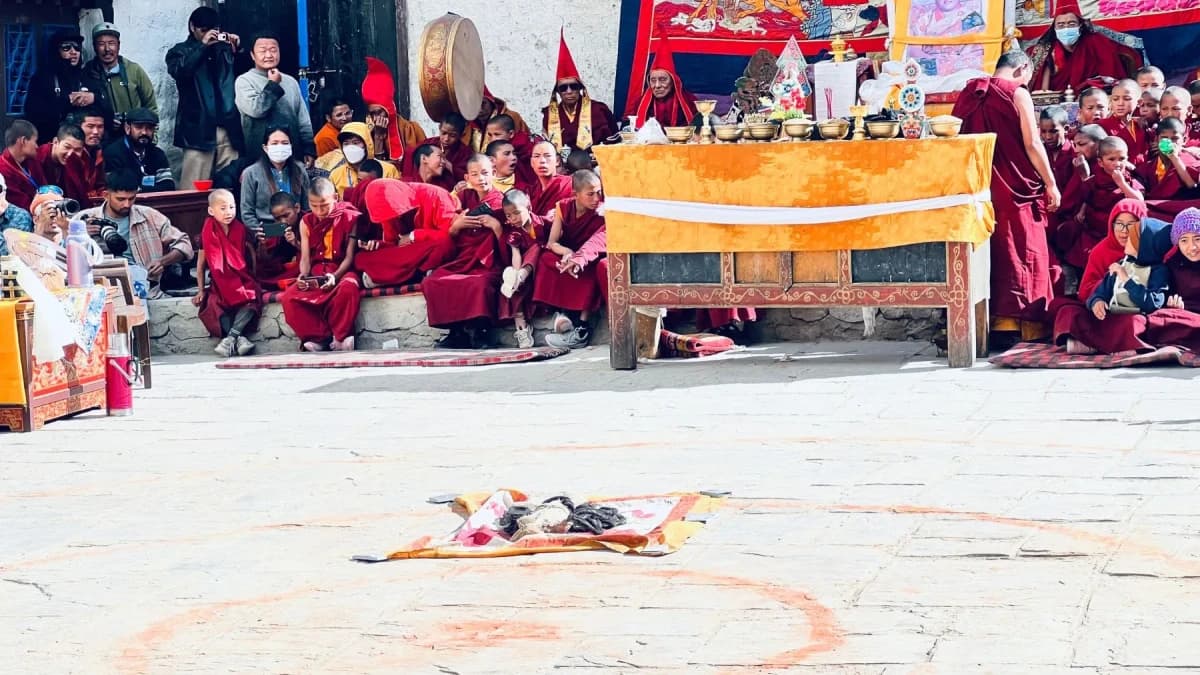
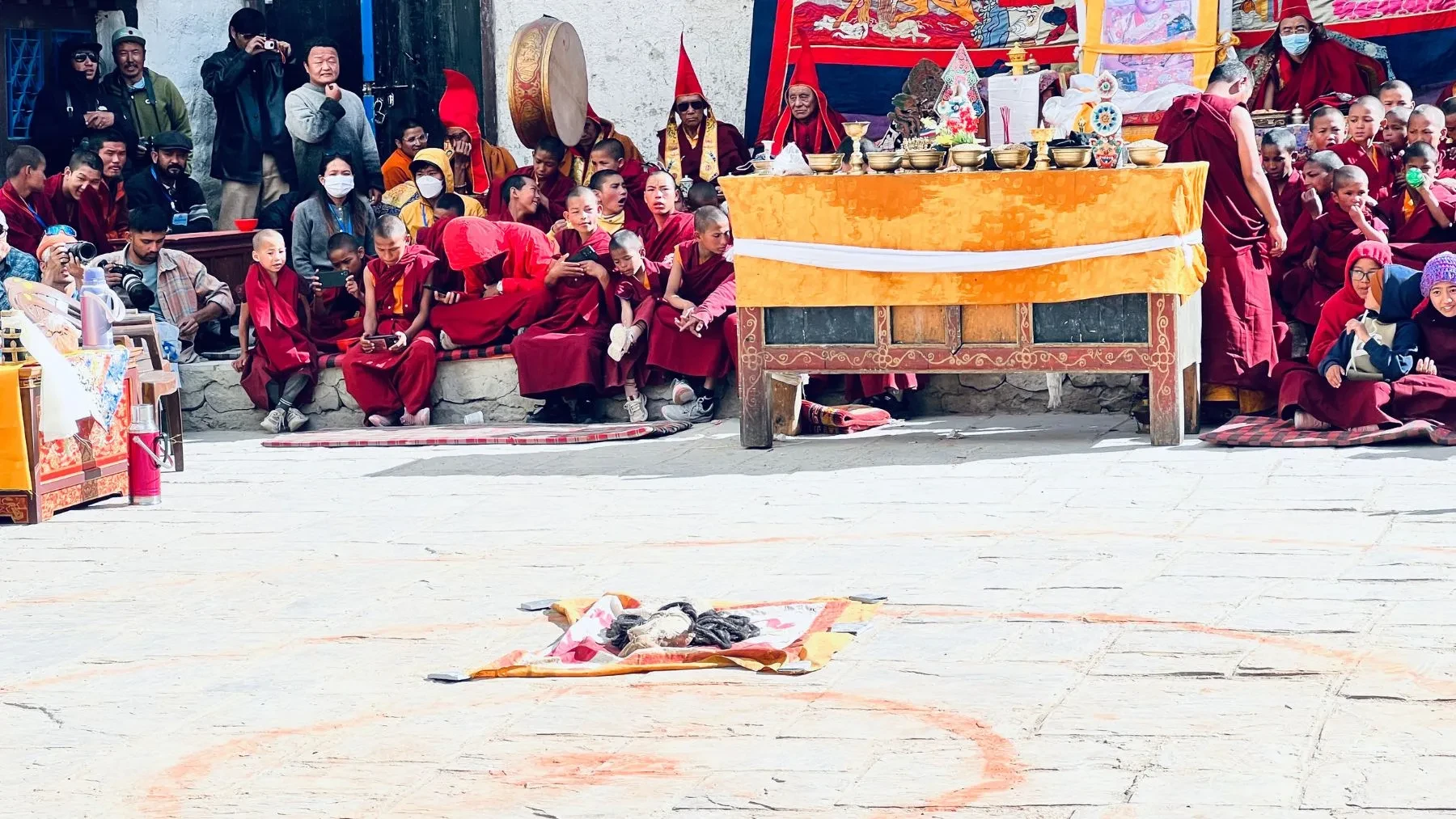
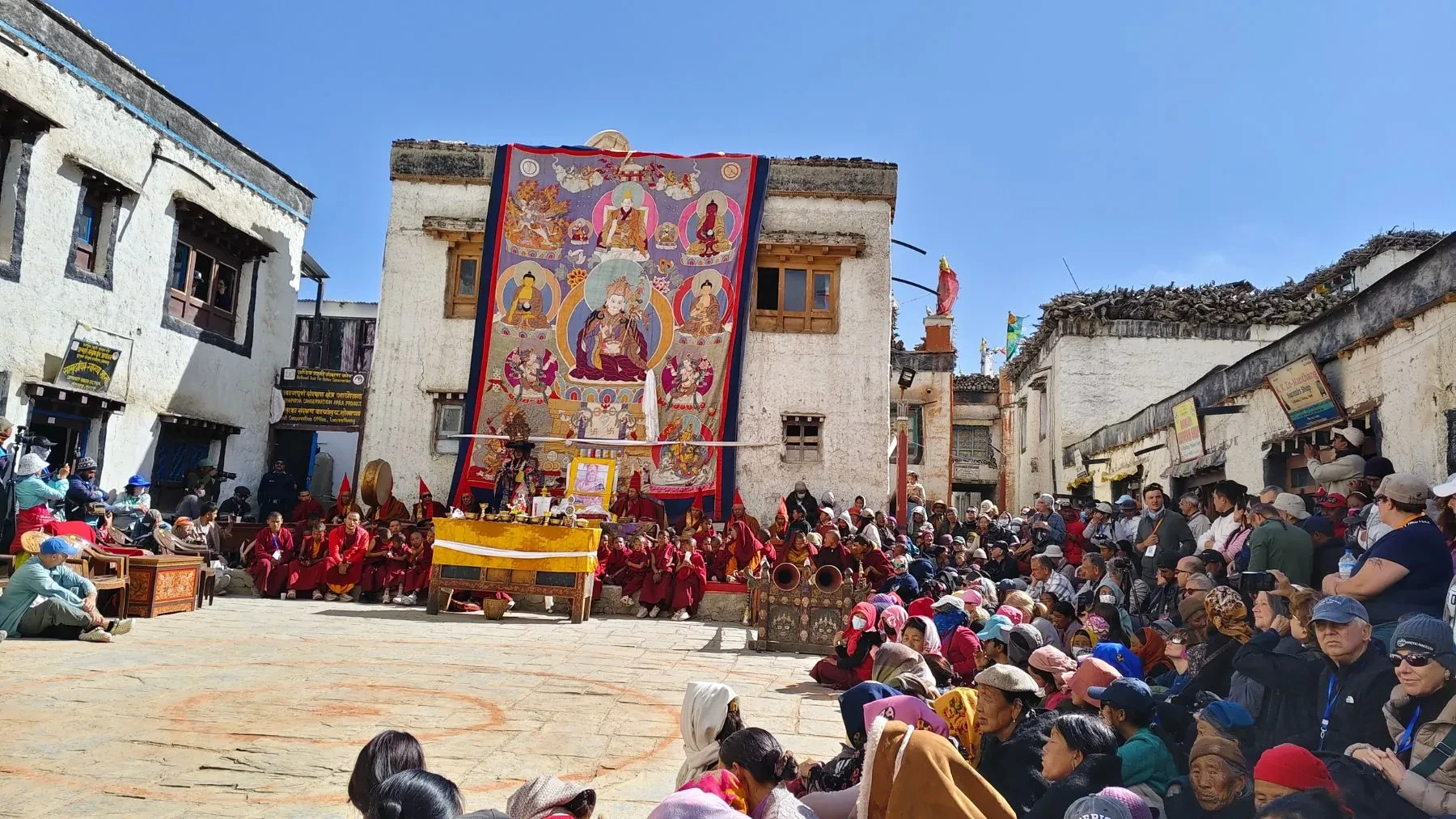
The festival is held in an open stone courtyard in front of the Royal Palace (Tashi Gephel Palace), adjoining Chhoede/Choedhe Monastery.
The Journey to Lo Manthang Is Part of the Experience
The approach to Lo Manthang takes travelers progressively farther into the distinctive landscape of Upper Mustang.
The route passes through:
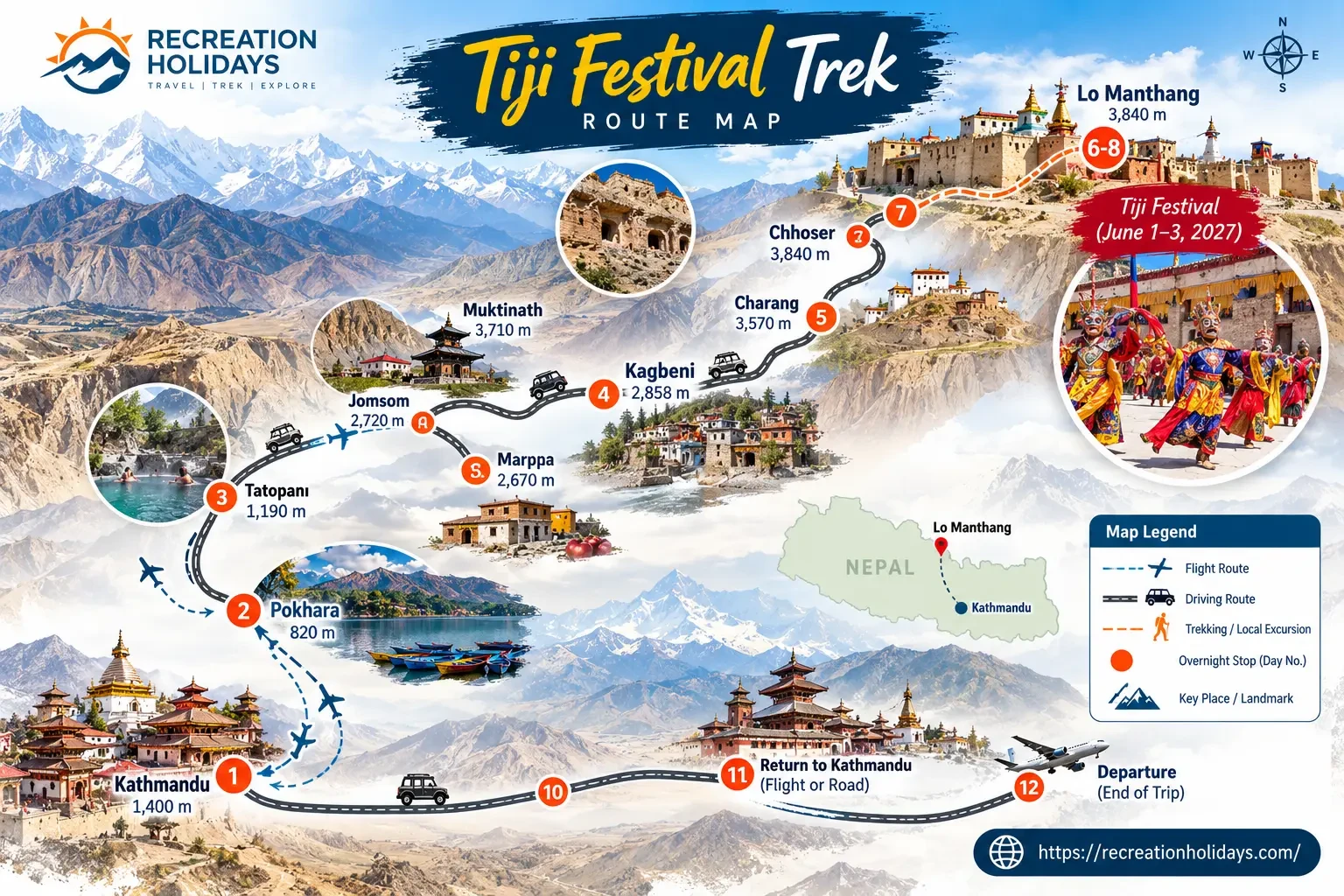
Kathmandu → Pokhara → Tatopani → Marpha → Jomsom → Muktinath → Kagbeni → Upper Mustang → Lo Manthang
The landscape changes progressively from the lower Kali Gandaki region toward the dry, high-altitude terrain of Mustang. Along the way, the journey incorporates places such as Marpha, Jomsom, Muktinath, Kagbeni and Charang, before reaching Lo Manthang. The route therefore provides more than access to the festival; it introduces travelers to the geography and settlements of the Mustang region.
The altitude also changes substantially. Kagbeni is approximately 2,858 m, while Charang is approximately 3,570 m, and Lo Manthang is approximately 3,840 m.
You Experience Upper Mustang Before and After the Festival
The experience does not end when the final festival ceremony finishes. Before Tiji, the itinerary takes travelers through the Mustang corridor toward Lo Manthang. During the festival period, Lo Manthang becomes the central base for experiencing the three-day celebration. After the festival, the journey continues through Mustang on the return route rather than immediately ending at the festival grounds.
The itinerary also includes Chhoser, where the Jhong Cave complex also referred to as Shija Jhong Cave in the supplied itinerary is located. The complex is described as a centuries-old cliff dwelling with roughly 44 rooms and lies approximately one hour from Lo Manthang.
This before-and-after structure is an important part of the Tiji Festival Trek itinerary: the festival is the central event, but the surrounding Upper Mustang journey provides the geographical and cultural context for reaching Lo Manthang.
What Will You Actually Experience on the Tiji Festival Trek?
The Tiji Festival Trek combines the approach through Upper Mustang, time in Lo Manthang and three days of Tiji celebrations. The experience includes changing mountain landscapes, high-altitude travel, historic settlements, monasteries and the opportunity to observe the festival within its traditional setting.
1. Before Reaching Lo Manthang
The journey begins in Kathmandu before continuing toward Pokhara and the Mustang region. From Pokhara, the documented itinerary travels through Tatopani, Marpha, Jomsom, Muktinath and Kagbeni before entering Upper Mustang.
This progression gives the journey a clear geographical sequence. The lower Kali Gandaki region gradually gives way to the drier, higher landscapes of Mustang, while the overnight elevations rise from approximately 820 m in Pokhara to 2,858 m at Kagbeni and 3,570 m at Charang before reaching Lo Manthang at approximately 3,840 m.
That altitude progression is also one of the most important practical aspects of the trip. Travelers should expect the high-altitude environment to become increasingly noticeable as the journey progresses northward.
2. Your First View of Lo Manthang
Arriving in Lo Manthang means reaching the historic walled settlement at the heart of Upper Mustang and the principal location of Tiji Festival.
At approximately 3,840 m, Lo Manthang is considerably higher than the lower Mustang settlements visited earlier in the journey. The town becomes the base for the three festival days and provides access to nearby cultural sites, including Chhoser.
For photography, the approach itself is part of the visual experience: the landscape becomes increasingly arid and exposed as the route moves deeper into Upper Mustang.
What the Festival Days Feel Like?
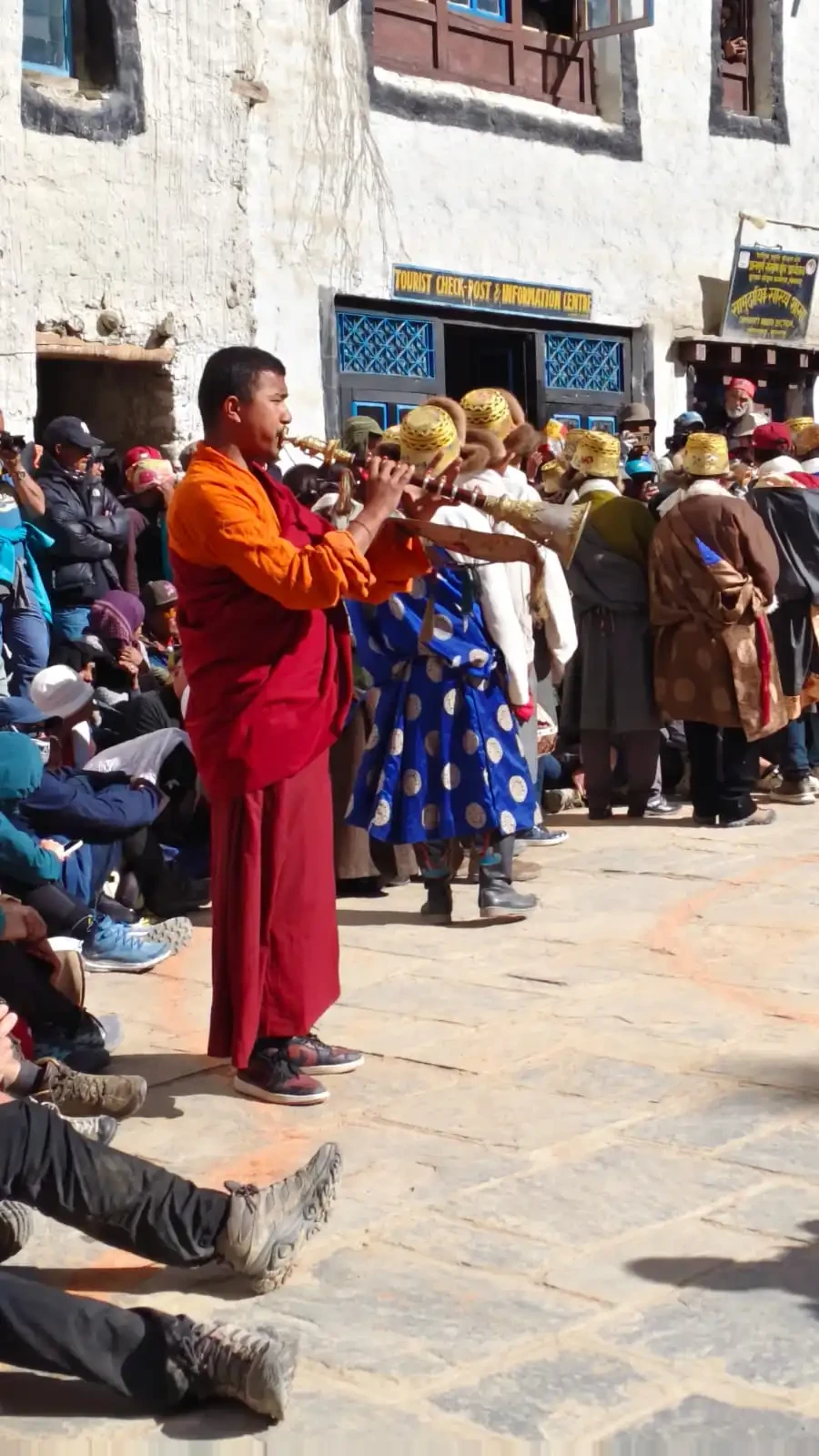
A Tiji Festival day is different from an ordinary trekking day. Instead of spending the entire day moving along a trail, visitors spend time around the festival area observing the ceremonies, with periods of standing, sitting, waiting and moving between viewing positions.
At approximately 3,840 m, altitude remains a consideration throughout the festival. Early June conditions in Upper Mustang can also include strong sun, dry conditions and afternoon winds, making layers, sun protection, water and wind protection practical considerations.
Visitors should also plan around photography rather than assuming they can move freely through the ceremony area. Respectful observation is important because Tiji is a living religious tradition, not simply a performance staged for tourists.
A lightweight daypack is useful for carrying water, an extra clothing layer, sun protection and camera equipment. Extra batteries or a power bank are also practical because charging facilities in Upper Mustang can be limited and may rely on solar power.
After the Festival
Once the final day of Tiji concludes, the journey continues through Upper Mustang rather than ending with the ceremony.
The documented itinerary includes a return journey toward Jomsom, followed by the return to Kathmandu using the available flight or road arrangements. Chhoser and its cave complex also form part of the itinerary, giving travelers an opportunity to explore another important Upper Mustang location around the festival period.
This makes the Tiji Festival Trek 2027 more than a three-day festival visit: the festival provides the central reason for the journey, while the route through Mustang, Lo Manthang and surrounding settlements provides the wider travel experience.
What Is Tiji Festival?
Tiji Festival, also known as Tenchi, is a three-day Buddhist festival held in Lo Manthang, Upper Mustang. For the Tiji Festival Trek 2027, the festival is scheduled for June 1–3, 2027, at approximately 3,840 m (12,600 ft). Ceremonies take place in the open stone courtyard in front of Tashi Gephel Palace, beside Chhoede/Choedhe Monastery.
Why Is Tiji Important?
Tiji is a living religious and cultural tradition of Lo Manthang, not simply a performance for visitors. Travelers should observe respectfully, follow local instructions and avoid disrupting ceremonies for photography. The festival's detailed mythology, rituals and historical background are covered in our dedicated guide:
For complete guide → Tiji Festival Travel Guide
What Happens During the Three Days of Tiji Festival?
The three festival days are known as Tsa Chham, Nga Chham and Rha Chham.
| Day |
Festival |
What Travelers Experience |
Practical Considerations |
| Day 1 |
Tsa Chham |
First day of the ceremonial sequence |
Carry water, layers and sun/wind protection |
| Day 2 |
Nga Chham |
Second day of ceremonies in Lo Manthang |
Expect periods of sitting, standing and waiting |
| Day 3 |
Rha Chham |
Final day of the festival |
Allow sufficient time for the complete ceremony before departure activities |
What Is a Tiji Festival Day Like Physically?
A festival day is physically different from a trekking day. At approximately 3,840 m, travelers may spend extended periods sitting, standing and waiting outdoors rather than continuously walking. Sun, wind, cold, hydration and fatigue therefore remain important considerations.
In early June, Upper Mustang generally experiences 18–25°C (64–77°F) daytime temperatures and 5–10°C (41–50°F) at night, with dry conditions, possible afternoon winds and occasional brief showers.
Carry:
- Water and a lightweight daypack
- Warm and wind-resistant layers
- Sun protection
- Camera equipment and spare batteries/power bank
- Comfortable clothing for extended outdoor viewing
Trekking Difficulty vs Festival-Day Demands
| Factor |
Trekking |
Festival Days |
| Walking |
Depends on the trekking route |
Short movements around the festival area |
| Altitude |
Increases toward Upper Mustang |
Approx. 3,840 m in Lo Manthang |
| Standing/waiting |
Usually limited |
Can be prolonged |
| Sun/wind |
Route and weather dependent |
Significant during outdoor ceremonies |
| Hydration |
Important throughout |
Carry water |
| Recovery |
Depends on trekking effort |
Consecutive high-altitude festival days can cause fatigue |
The key distinction: trekking difficulty comes primarily from the route and walking demands, while festival-day difficulty comes from altitude plus prolonged outdoor exposure, standing/waiting and limited recovery between consecutive festival days.
Tiji Festival Trek Altitude Progression
The key established altitude progression is Pokhara (~820 m) → Kagbeni (~2,858 m) → Charang (~3,570 m) → Lo Manthang (~3,840 m).
Technical note: This particular itinerary is primarily road-based, so fixed daily trekking distances, walking hours, elevation gains/losses and a highest trekking pass are not presented as fixed figures. That prevents the road-based Tiji Festival Trek itinerary from being incorrectly described as a continuous multi-day walking trek.
How Much Does the Tiji Festival Trek Cost?
The Tiji Festival Trek costs US$[2850] per person for the complete 12-day journey through Upper Mustang to Lo Manthang, including the services specified in the package. The price covers [confirmed inclusions], while [confirmed exclusions] are paid separately. This fixed Tiji Festival Trek price gives travelers a clear understanding of the total package cost without relying on estimated market rates.
Tiji Festival Trek Route & Altitude at a Glance
| Location |
Approx. altitude |
Role in the itinerary |
| Kathmandu |
1,400 m |
Arrival/departure |
| Pokhara |
820 m |
Gateway to Mustang |
| Jomsom |
~2,715–2,810 m |
Mustang travel hub |
| Kagbeni |
~2,858 m |
Gateway toward Upper Mustang |
| Charang |
~3,570 m |
Upper Mustang settlement |
| Lo Manthang |
~3,840 m / 12,600 ft |
Tiji Festival base |
How Difficult Is the Tiji Festival Trek?
The Tiji Festival Trek difficulty depends on altitude, terrain, travel duration and festival-day conditions rather than a single difficulty label.
| Difficulty factor |
What to expect |
| Walking |
Local walking and exploration rather than continuous multi-day trekking |
| Altitude |
High; Lo Manthang reaches approx. 3,840 m |
| Terrain |
Dry, rocky and exposed Upper Mustang environment |
| Daily duration |
Varies according to road travel and activities |
| Elevation progression |
Approx. 820 m at Pokhara → 2,858 m Kagbeni → 3,570 m Charang → 3,840 m Lo Manthang |
| Festival days |
Standing, sitting and waiting outdoors at high altitude |
| Weather exposure |
Sun, wind, cold and possible brief showers |
| Accommodation |
Mountain lodges/tea houses in a remote Himalayan region |