
Tiji Festival 2027 is scheduled for June 1–3 in Lo Manthang, Upper Mustang, Nepal. This three-day Tibetan Buddhist festival reenacts the victory of Dorje Jono over the demon Ma Tam Ru Ta, symbolizing the protection of the valley from drought, disease and destruction. Travelers come to witness its masked dances, rituals and ceremonies, but Tiji is a living religious tradition- not simply a tourist performance. This Tiji Festival 2027 guide explains the dates, three-day events, cultural meaning, permits, travel planning, altitude, weather and respectful ways to experience the festival.
Tiji Festival 2027: Complete Guide to Dates, Events, Culture and Visiting Lo Manthang
Tiji Festival 2027 at a Glance
| Information | Details |
|---|---|
| Festival dates | June 1–3, 2027 |
| Day 1 | Tuesday, June 1 — Tsa Chham |
| Day 2 | Wednesday, June 2 — Nga Chham |
| Day 3 | Thursday, June 3 — Rha Chham, final ceremony |
| Location | Lo Manthang, Upper Mustang, Nepal |
| Main venue | Open stone courtyard before the Royal Palace (Tashi Gephel Palace), adjoining Chhoede/Choedhe Monastery |
| Duration | 3 days |
| Best arrival | May 30 or 31, 2027 |
| Recommended stay | 5–14 days, depending on festival-only or trekking itinerary |
What Is Tiji Festival?
Tiji, the common name for Tenchi, comes from Tenpa Chirim, meaning “Prayer for World Peace.” It is a centuries-old Vajrayana/Tibetan Buddhist tradition that reenacts Dorje Jono’s defeat of the demon Ma Tam Ru Ta, who represents drought, disease and destruction. The story reflects the community’s spiritual belief in protecting Mustang and its agricultural way of life.
Where Is Tiji Festival Celebrated?
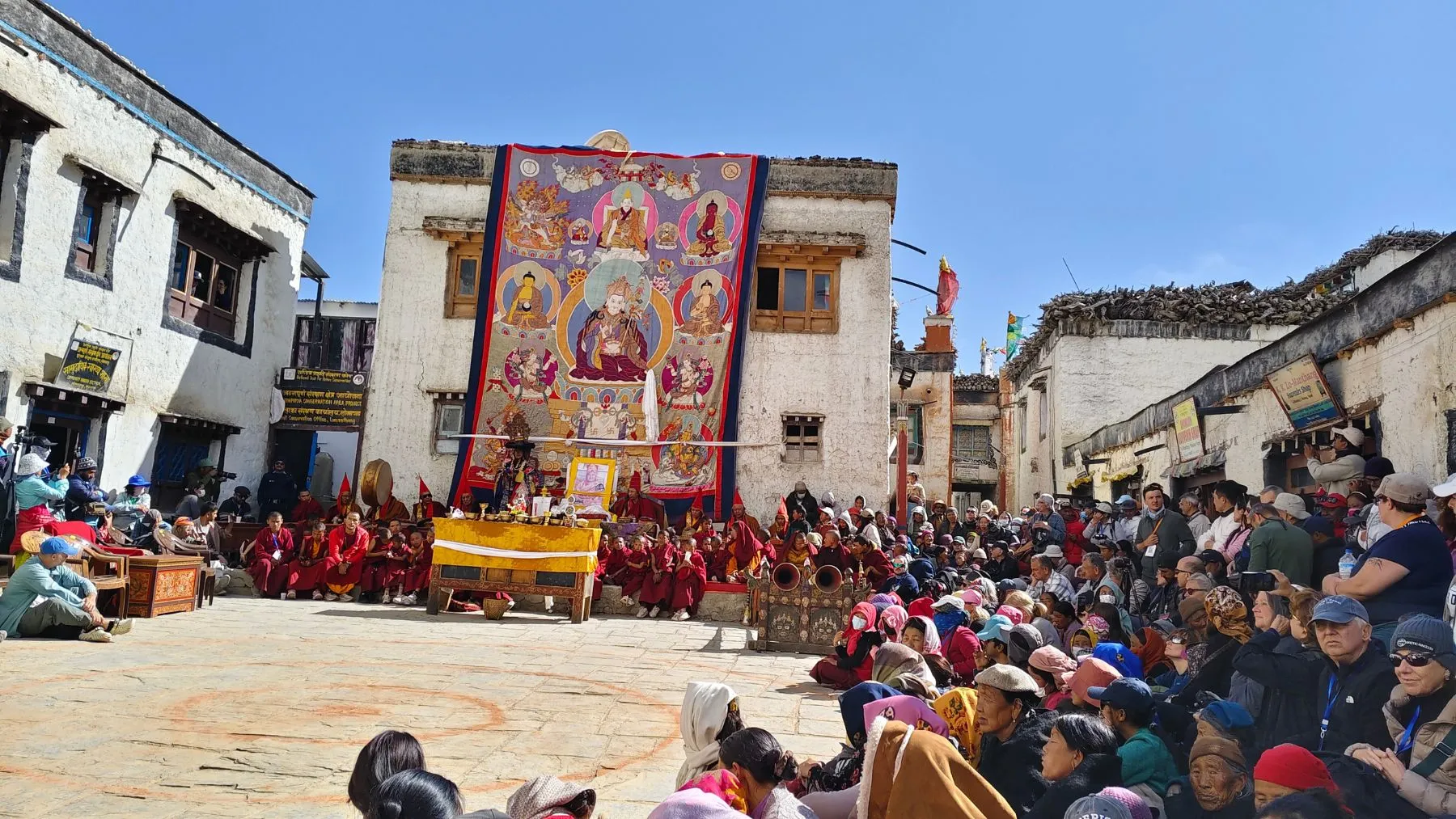
The Tiji Festival Nepal takes place in Lo Manthang, the historic walled settlement of Upper Mustang. The main ceremonies are held in the open stone courtyard beside the Royal Palace (Tashi Gephel Palace) and Choedhe/Chhoede Monastery, making Tiji Festival Lo Manthang deeply connected to the cultural landscape of the town.
Who Celebrates Tiji Festival?
The festival is performed by monks of Choedhe/Chhoede Monastery, while the wider Lo Manthang community participates in and supports the tradition. For this reason, Tiji should be understood as a living religious and community tradition, rather than simply a cultural performance for visitors.
The History and Origins of Tiji Festival
Tiji is a centuries-old Vajrayana Buddhist tradition rooted in Tibetan Buddhist tantric practice. The available research does not establish a definitive founding year, with sources describing the tradition as roughly 300 to 400+ years old; therefore, a precise origin date should not be presented as fact. Its central narrative and rituals became embedded within Mustang’s Tibetan Buddhist cultural heritage, where the tradition has been preserved through the religious community of Lo Manthang.
The festival’s Buddhist connection centers on Dorje Jono, a wrathful protective deity associated with the defeat of Ma Tam Ru Ta, the demon representing drought, disease and destruction. Tiji’s rituals therefore combine mythology, tantric Buddhist practice and symbolic protection of the Mustang valley.
How Has Tiji Been Preserved Over Time?
Tiji has remained a living religious tradition, performed by monks of Choedhe/Chhoede Monastery rather than created as a performance for tourists. A particularly important role is the Tsowo, the chief dancer and monk who undergoes a multi-month meditation retreat before embodying Dorje Jono during the festival.
The tradition has become more accessible to outside visitors as transportation and tourism in Upper Mustang have developed, but the available research does not provide a precise historical timeline for these changes. It is therefore more accurate to describe Tiji as a preserved religious practice that now receives visitors while retaining its community and ritual significance.
Why Is the Tiji Festival Important?
The Tiji Festival significance extends across three interconnected dimensions. Religiously, it reenacts Dorje Jono’s victory over a destructive force. Culturally, it preserves Mustang’s Tibetan-influenced Buddhist traditions, ritual knowledge, masks, dances and ceremonial practices. Communally, it remains an important gathering for the people of Lo Manthang and surrounding communities.
Its continuing celebration reflects a shared connection between Buddhist belief, community identity, cultural heritage and the symbolic protection of the Mustang valley. Visitors can observe and photograph the ceremonies, but they are participating as guests in a living religious tradition whose meaning extends far beyond tourism.
When is the Tiji Festival 2027?
The Tiji Festival 2027 dates are June 1–3, 2027, in Lo Manthang, Upper Mustang, Nepal. Tiji follows the Tibetan lunar calendar, so its dates change each year and are determined through Chhoede Monastery’s astrological calculation rather than a fixed Gregorian date.
| Day | Date | Ceremony |
|---|---|---|
| Day 1 | June 1, 2027 (Tuesday) | Tsa Chham |
| Day 2 | June 2, 2027 (Wednesday) | Nga Chham |
| Day 3 | June 3, 2027 (Thursday) | Rha Chham |
What Happens During the Three Days of Tiji Festival?
Day 1 : Tsa Chham
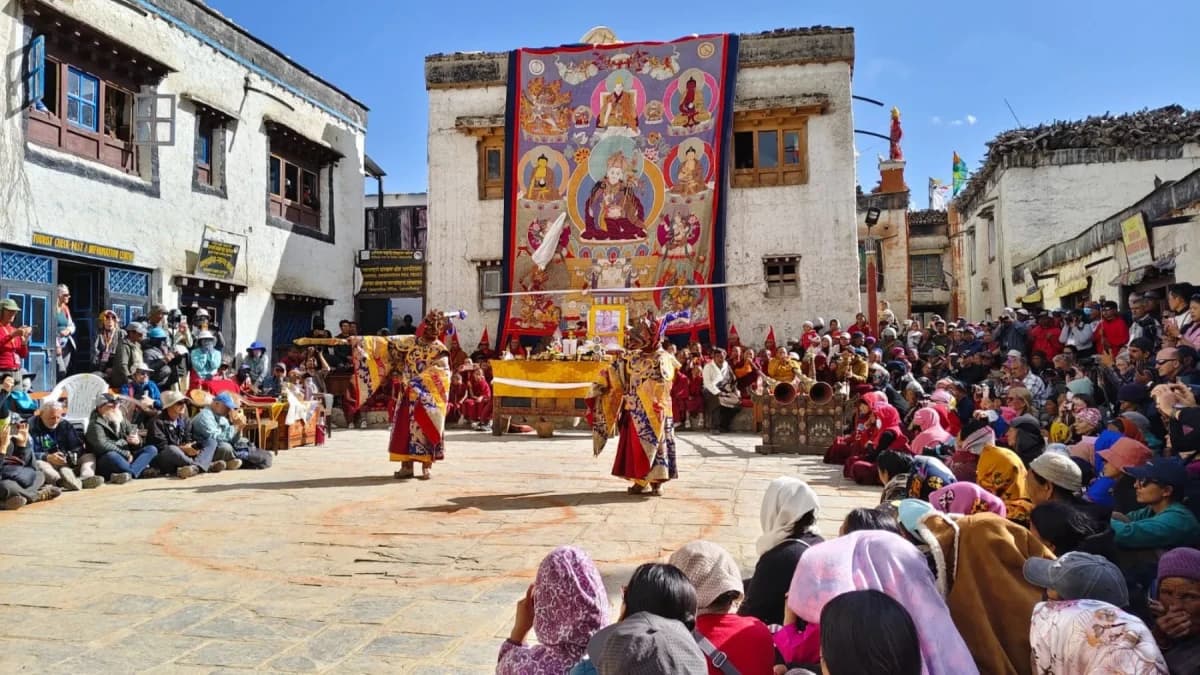
Tsa Chham begins the three-day ceremony with purification rites and invocations of protective deities. Monks wear elaborate masks and brocade costumes and perform slow, deliberate movements. A large thangka of Padmasambhava and Dorje Jono is displayed on the palace wall, while dungchen long horns announce the ceremony. The atmosphere is comparatively subdued, with local families also preparing food offerings.
Day 2 : Nga Chham
Nga Chham intensifies the story's confrontation with the demon Ma Tam Ru Ta. The masked dances become more dramatic, particularly through representations of wrathful protective deities. This is generally the most visually striking day for visitors. Some sources report a city-wall circumambulation, but its exact timing is inconsistent and should be verified locally.
Day 3 : Rha Chham
Rha Chham is the festival's climax. The Tsowo, the chief dancer and monk who undergoes a multi-month meditation retreat, embodies Dorje Jono and symbolically defeats the demon by piercing its effigy with a phurba, a three-pronged ritual dagger. The torma representing the demon is destroyed or banished, followed by ceremonial musket fire, the “Lha Gyalo!” victory chant and closing dances.
| Day | Main Events | Cultural Meaning | Visitors See |
|---|---|---|---|
| 1 | Purification, invocations, thangka display, Tsa Chham | Preparation and protection | Masks, slow dances, dungchen |
| 2 | Nga Chham, intensified masked dances | Confrontation with destructive forces | Dramatic dances, wrathful masks |
| 3 | Rha Chham, phurba, effigy destruction | Defeat and banishment of the demon | Tsowo, musket fire, “Lha Gyalo!” |
Tiji Festival Masks, Dances and Rituals Explained
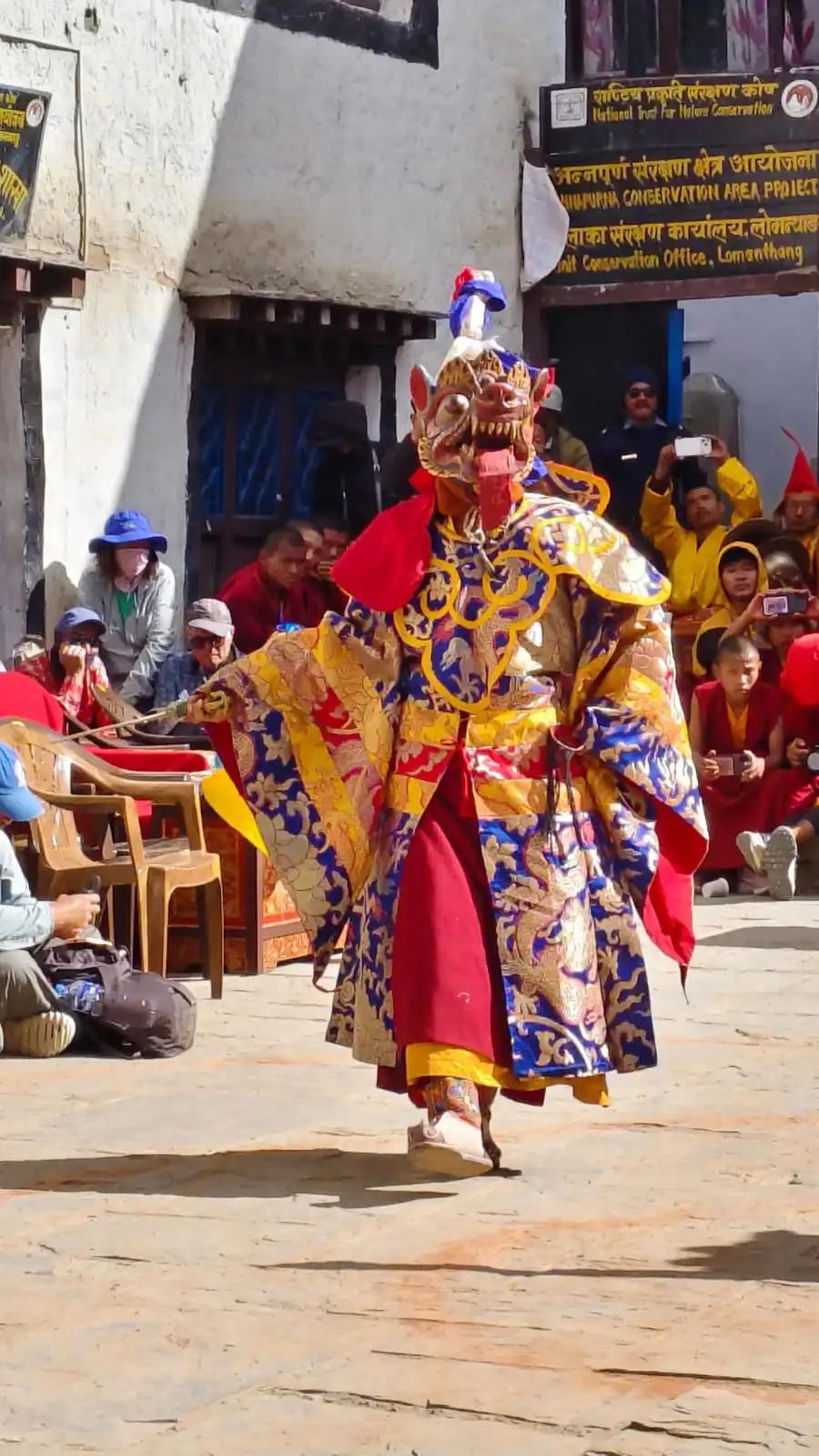
The masks represent deities, wrathful protectors, animals and demons, while Cham dances progressively reenact the mythological battle. Elaborate brocade and silk costumes identify ritual characters and are part of the formal ceremony, not decoration.
Key ritual objects include the phurba, the torma demon effigy, and the Padmasambhava–Dorje Jono thangka. The research confirms dungchen long horns but does not independently verify a complete instrument list, so additional instruments should not be stated as definitive.
| Element | Meaning / Role | Main Timing |
|---|---|---|
| Masks | Deities, protectors and mythological figures | All 3 days |
| Cham dances | Reenact the battle | All 3 days |
| Costumes | Formal ritual identity | All 3 days |
| Dungchen | Ceremonial long horns | Festival ceremonies |
| Phurba & torma | Symbolic defeat and destruction of the demon | Mainly Day 3 |
| Final ceremony | Effigy destruction, musket fire and victory chant | Day 3 |
What Is It Like to Experience the Tiji Festival?
The Tiji Festival in Lo Manthang takes place in a historic stone courtyard beside the Royal Palace and Choedhe Monastery. Visitors hear ceremonial horns, watch masked monks perform deliberate movements and share the space with local residents participating in a living religious tradition.
For first-time visitors, altitude and limited accommodation can be more challenging than the ceremonies themselves. Lo Manthang sits at approximately 3,840 m (12,600 ft). Photography is generally possible, but ask before close-up shots, avoid flash, never touch ritual objects or costumes, and stay outside the dance area and reserved spaces.
Who Should Visit the Tiji Festival?
Tiji suits travelers who value cultural immersion, Buddhist traditions and remote Himalayan landscapes more than conventional sightseeing. It is particularly rewarding for cultural travelers, photographers, Upper Mustang trekkers and visitors interested in Tibetan Buddhist ritual.
| Traveler Type | Why Tiji May Suit Them | Main Consideration |
|---|---|---|
| Cultural traveler | Living Buddhist tradition and local community setting | Respect religious practices |
| Photographer | Masks, costumes, dances and dramatic ceremonies | Ask before close-ups; no flash |
| Trekker | Can combine the festival with an Upper Mustang route | Altitude and multi-day travel |
| First-time visitor | Unique introduction to Mustang culture | Remote access and ~3,840 m altitude |
| Short-trip traveler | Festival-focused jeep travel avoids a full trek | Limited accommodation; plan early |
Do You Need to Trek the Upper Mustang to Attend the Tiji Festival?
No. You do not need to complete the Upper Mustang trek to attend Tiji. Attending the festival, reaching Lo Manthang, traveling through Upper Mustang and undertaking a full trek are different travel choices. A festival-focused Tiji Festival trip can use jeep transportation, while trekkers can build the three-day ceremony into a longer Tiji Festival Upper Mustang trek.
| Trip Style | Festival | Trekking | Typical Time | Best For |
|---|---|---|---|---|
| Festival-focused | ✓ | No | ~5–7 days | Festival-first travelers |
| Festival + Lo Manthang | ✓ | No | ~5–7 days | Culture and sightseeing |
| Festival + Upper Mustang | ✓ | ✓ | ~10–14 days | Trekkers and explorers |
| Extended Mustang trip | ✓ | ✓ | 14+ days | Deeper regional experience |
Tiji Festival Trek Itinerary
Follow the day-by-day journey through Mustang and experience the unique Tiji Festival in Lo Manthang.
Day 1: Arrival in Kathmandu – Begin Your Mustang Adventure
27 May 2027 · Elevation: 1,350m
You will be welcomed by a representative of Global Holidays Adventure at the international terminal in Kathmandu. You will then be transferred to the hotel by private vehicle. Later in the evening, we will conduct a small briefing about the trip.
Accommodation: Hotel
Transport: Private Vehicle
Day 2: Fly to Pokhara & Discover the City of Lakes
28 May 2027 · Elevation: 820m
Early morning, you will fly to Pokhara from the domestic terminal of Tribhuwan International Airport. Our office representative will pick you up from the airport and transfer you to the hotel. You will then enjoy half-day sightseeing around Pokhara city.
Accommodation: Hotel
Meals: Breakfast
Transport: Private Land Cruiser or Mahindra Scorpio
Day Highlights
- Enjoy Himalayan views from the flight.
- Visit World Peace Pagoda.
- Visit Devi's Fall and Mahendra Cave.
- Visit the International Mountain Museum.
- Enjoy the evening around Phewa Lakeside.
- Boating as an additional activity.
Day 3: Scenic Drive to Tatopani & Natural Hot Spring
29 May 2027 · Elevation: 1,190m · 5 hours / 110 km
Start the day with breakfast before driving along winding mountain roads while enjoying views of mountains, local lifestyles, farms, rivers and gorges. In the evening, relax at the natural hot spring of Tatopani.
Accommodation: Lodge with attached bathroom
Meals: Breakfast, Lunch and Dinner
Transport: Private Land Cruiser or Mahindra Scorpio
Day Highlights
- Sunrise from the mountains at Sarangkot viewpoint.
- Adventure drive through Kaligandaki Gorge.
- Natural hot spring dip, if interested.
Day 4: Drive to Kagbeni via Marpha, Jomsom & Muktinath
30 May 2027 · Kagbeni · 4–5 hours / around 80 km
Early morning, pick up from the hotel and drive towards Kagbeni. Along the way, visit Marpha village, the local market of Jomsom and Muktinath Temple before continuing towards Kagbeni.
Accommodation: Lodge with attached bathroom
Meals: Breakfast, Lunch and Dinner
Transport: Private Land Cruiser or Mahindra Scorpio
Day Highlights
- Rupse Waterfall.
- Marpha village, Jomsom and Kagbeni.
- Views of Nilgiri.
- Muktinath Temple.
- Jal Devi natural gas flame.
- Jharkot Buddhist monastery.
Day 5: Enter Upper Mustang & Discover Its Arid Landscape
31 May 2027 · Charang · Elevation: 3,570m · 5 hours / 40 km
After completing permit formalities at Kagbeni, continue through the fascinating landscapes of Upper Mustang, passing villages such as Chele, Samar and Ghiling before reaching Charang.
Accommodation: Lodge with attached bathroom
Meals: Breakfast, Lunch and Dinner
Transport: Private Land Cruiser or Mahindra Scorpio
Day Highlights
- Tibetan Plateau and arid landscapes.
- Local lifestyle and culture.
- Sky caves and reddish-orange cliffs.
- White-washed settlements.
Day 6: Reach Lo Manthang & Witness the Tiji Festival
1 June 2027 · Elevation: 3,800m · Tiji Festival Begins
Explore Lo Gyagar Ghar Gumba before continuing towards Lomanthang. Along the way, witness Tibetan plateaus, cliffs and sky caves. After lunch, head to the King's Palace to experience the Tiji Festival, including rituals and dancing by Tibetan monks.
Accommodation: Lodge with attached bathroom
Meals: Breakfast, Lunch and Dinner
Transport: Private Land Cruiser or Mahindra Scorpio
Day Highlights
- Explore Lo Gyagar Ghar Gumba.
- Admire Lo Manthang from the viewpoint.
- Explore the walled kingdom.
- Visit the King's Palace.
- Witness Tiji Festival rituals and cultural dances.
- Interact with local people.
Day 7: Chhoser Village, Sky Caves & Tiji Celebration
2 June 2027 · Lo Manthang
In the morning, head towards Chhoser village, around one hour from Lomanthang. Explore the village's sky caves and Buddhist school before returning to Lomanthang for the Tiji celebration.
Day Highlights
- Visit Chhoser.
- Explore Shija Jhong Cave.
- Visit Lowo Nyiphug Namdrol Norbuling Monastery.
- Celebrate Tiji Festival with local people.
Day 8: Final Day of the Tiji Festival in Lo Manthang
3 June 2027 · Tiji Festival Finale
Explore the monasteries and Buddhist school of Lomanthang before joining the locals after noon for the final day of the Tiji Festival. Experience the rituals, dances and ending ceremony before returning to the hotel.
Day Highlights
- Explore the monasteries of Lomanthang.
- Discover the local lifestyle.
- Celebrate Tiji Festival with local people.
- Participate in the ending ceremony of Tiji Festival.
Day 9: Drive Back to Jomsom Through Mustang
4 June 2027 · Jomsom · Elevation: 2,743m · 5–6 hours / around 70 km
Drive back to Jomsom, retracing the route through Tsarang, Ghami, Ghiling, Samar and Kagbeni. After completing the special permit checkout at Kagbeni, continue to Jomsom and explore the local market.
Accommodation: Lodge with attached bathroom
Meals: Breakfast, Lunch and Dinner
Transport: Private Land Cruiser or Mahindra Scorpio
Day 10: Return to Kathmandu by Flight or Road
5 June 2027 · 25-minute flight / about 6 hours by road
The flight from Pokhara will bring you back to Kathmandu, while the road journey takes approximately 6 hours. Upon arrival, enjoy a relaxing evening in Kathmandu.
Accommodation: Hotel
Meals: Breakfast and Lunch
Transport: Private Land Cruiser or Mahindra Scorpio
Day 11: Fly / Drive Back to Kathmandu
6 June 2027 · 25-minute flight / about 6 hours by road
Return to Kathmandu by flight or road and enjoy your final evening in the city.
Accommodation: Hotel
Meals: Breakfast
Transport: Flight / Private Land Cruiser or Mahindra Scorpio
Day 12: Final Departure from Kathmandu
7 June 2027 · Trip Concludes
Enjoy free time for shopping and packing until your final departure. Our office representative will drop you at the airport by private vehicle for your onward journey.
Meals: Breakfast
Transport: Private Vehicle
How to Attend Tiji Festival 2027?
The main Tiji Festival Lo Manthang ceremonies take place in the open stone courtyard in front of the Royal Palace (Tashi Gephel Palace), adjoining Choedhe/Chhoede Monastery. For the June 1–3, 2027 festival, arrive in Lo Manthang by May 30 or 31 to allow a buffer for remote-area transport delays and secure accommodation before demand peaks. Plan for approximately 5–14 days overall. A festival-focused trip by jeep can be shorter, while combining the Upper Mustang trek with Tiji requires substantially more time.
What Should You Arrange and Book in Advance?
Foreign visitors should arrange the Upper Mustang Restricted Area Permit (RAP), Annapurna Conservation Area Permit (ACAP) requirements and a licensed guide through a registered Nepali trekking agency. Also arrange transport and travel insurance covering high-altitude emergency evacuation before departure.
Accommodation is the main constraint. Lo Manthang has limited guesthouses, homestays and lodges, ranging from basic shared facilities to upgraded rooms, so booking several months ahead is advisable. Transport should also be prearranged for the June 1–3 festival period because visitor demand is concentrated around these dates.
How to Get to Lo Manthang for Tiji Festival?
The practical route is Kathmandu → Pokhara → Jomsom → Lo Manthang. From Kathmandu to Pokhara, allow 6–8 hours by road or about 25–30 minutes by domestic flight. Pokhara to Jomsom takes about 20–30 minutes by scenic flight or roughly 7–8 hours by road; flights are weather-dependent and early-morning departures are preferable because afternoon winds through the Kali Gandaki Gorge can disrupt flights.
From Jomsom, a jeep can reach Lo Manthang in about 6–8 hours directly, although splitting the journey over 2–3 days through places such as Kagbeni and Chuksang/Ghiling provides better acclimatization. A trekking approach generally takes 4–6 days, with about 5–6 hours of walking per day through Kagbeni, Chele, Syangboche/Samar and Dhakmar/Ghami. Much of the Jomsom–Lo Manthang road was still gravel as of 2025; its paving status should be checked before the 2027 festival.
What Permits Do You Need for Tiji Festival 2027?
For foreign visitors, the key requirements are the Upper Mustang Restricted Area Permit (RAP), Annapurna Conservation Area Permit (ACAP) and a licensed guide arranged through a registered Nepali trekking agency. The current RAP is US$50 per person per day for travel north of Kagbeni, with no longer a fixed 10-day minimum; a three-day festival visit therefore costs about US$150 in RAP fees alone. ACAP is NPR 3,000.
The old US$500/10-day RAP was abolished in late 2025, and the minimum-two-foreign-trekkers rule was removed in March 2026. Solo travel is now permitted, but the guide requirement remains mandatory. Applications are handled through registered Kathmandu- or Pokhara-based agencies, typically taking 3–7 working days; permits are non-refundable, non-transferable and single-entry. TIMS requirements remain inconsistent across current sources, so confirm with your agency, particularly if your itinerary also includes the Annapurna Circuit or ABC.
| Requirement | Current information |
|---|---|
| Upper Mustang RAP | US$50/person/day; north of Kagbeni |
| ACAP | NPR 3,000 |
| Guide | Mandatory for foreign visitors |
| Solo travel | Allowed since March 22, 2026 |
| TIMS | Confirm for your specific itinerary |
Where to Stay During Tiji Festival?
Lo Manthang has limited guesthouses, homestays and lodges, making accommodation the main logistical bottleneck during Tiji. Options range from basic shared-bathroom homestays to upgraded guesthouses with attached bathrooms and solar-dependent hot water. Book several months ahead for the festival period.
Wi-Fi can be slow, patchy and weather-dependent and may cost roughly NPR 300–500/day; smaller villages may have no reliable connectivity. Electricity is generally solar-based, and hot water depends on available solar power. There are no ATMs in Upper Mustang, so carry sufficient Nepali rupees.
What Is the Weather Like During the Tiji Festival?
Because Tiji Festival 2027 falls in early June, do not rely on May weather information commonly repeated online. In Lo Manthang, daytime temperatures are roughly 18–25°C (64–77°F), while nights are around 5–10°C (41–50°F). Direct sun feels warm, but mornings and evenings remain cool.
Upper Mustang lies in the rain shadow of Annapurna and Dhaulagiri, so the early monsoon generally means increased afternoon cloud and a slightly higher chance of brief showers rather than sustained monsoon rain. Strong afternoon winds may begin easing later in June, while trails generally remain dry, rocky and dusty, with isolated damp patches after rain.
| Condition | What to Carry |
|---|---|
| Cool mornings/nights | Warm layers and insulating layer |
| Strong sun | Sunscreen, sunglasses, hat |
| Wind | Windproof outer layer |
| 18–25°C days / 5–10°C nights | Layering system |
| Occasional showers | Lightweight rain protection |
What Should You Pack for Tiji Festival 2027?
For Tiji Festival 2027, pack for cool nights, strong high-altitude sun and wind rather than heavy monsoon conditions. Lo Manthang is around 3,840 m (12,600 ft), with early-June daytime temperatures around 18–25°C (64–77°F) and nights around 5–10°C (41–50°F). Festival-only travelers need less technical gear than those undertaking a Tiji Festival trek 2027.
| Item | Festival Only | Festival + Trek | Priority |
|---|---|---|---|
| Warm layers | ✓ | ✓ | High |
| Sun protection | ✓ | ✓ | High |
| Comfortable footwear | ✓ | ✓ | High |
| Water bottle | ✓ | ✓ | High |
| Camera | Optional | Optional | Medium |
| Trekking equipment | — | ✓ | High |
| Personal medication | ✓ | ✓ | High |
Tiji Festival Etiquette for Visitors
Tiji is a living Buddhist religious tradition, so respectful behavior is essential. Dress modestly by covering shoulders, knees and chest; remove shoes inside monastery interiors and remove hats or sunglasses where appropriate. Walk clockwise around stupas and mani walls, maintain distance from dancers, and follow your guide's or monastery's instructions.
Photography and video are generally possible, but ask before close-up photographs of monks or local people, avoid flash during ceremonies, and respect any moment-specific restrictions. Never touch masks, costumes, sacred objects or ritual items, enter the dance ground, block sightlines, stand directly in front of the Padmasambhava thangka, or point your feet toward people, altars or the ceremonial space.
| Do | Don't |
|---|---|
| Follow local instructions | Interrupt ceremonies |
| Dress respectfully | Touch sacred objects |
| Respect religious spaces | Enter the dance area |
| Ask before close-up photography | Use flash during ceremonies |
| Maintain appropriate distance | Block dancers or sightlines |
How Many Days Do You Need for the Tiji Festival?
Your Tiji Festival itinerary depends on whether the priority is the three-day ceremony or a broader Upper Mustang Tiji Festival journey. A festival-focused jeep trip can generally fit within the shorter end of the recommended 5–14-day overall planning window, while a full Upper Mustang trek requires more time.
| Trip Type | Approx. Window | Main Experience | Best For |
|---|---|---|---|
| Festival-focused | ~5–7 days | Three festival days + travel | Shorter trips |
| Festival + Lo Manthang | ~5–7 days | Festival + local sights | Cultural travelers |
| Festival + Upper Mustang | ~10–14 days | Festival + multi-day trek | Trekkers |
| Extended Mustang | 14+ days | Festival + deeper regional exploration | Slow travelers |
Choose Your Tiji Festival Trek with Recreation Holidays
If you want to experience the Tiji Festival 2027 while exploring Upper Mustang, Recreation Holidays offers trekking options that can be matched to your available time and preferred travel style. Choose a festival-focused journey if the ceremonies are your priority, or combine Tiji with a longer Upper Mustang trek for deeper exploration of Mustang’s landscapes, villages and Buddhist heritage.
For travelers considering other Himalayan experiences, explore our Upper Mustang Trek, Annapurna Circuit Trek, Mardi Himal Trek, Everest Base Camp Trek, and Manaslu Circuit Trek as alternative or future trekking options.
Plan your Tiji Festival trek 2027 with Recreation Holidays and experience Lo Manthang beyond the ordinary tourist route.
Other Related Blogs Guides
Where Is Nepal Located in Asia?
Truth About Dead Bodies on Mount Everest
Need Help? Call Us+977 9851001069orChat with us on WhatsApp
Latest Travel Blogs
News and Events
Dashain 2026: Festival Dates, Tika Time, Rituals & Celebration Guide
Sep 24, 2026By Hari
News and Events
Rainbow Valley Everest | Death Zone of Mount Everest
Sep 17, 2026By Hari
Travel Tips
20 Best Things to Do in Pokhara, Nepal [2027 Guide]
Sep 12, 2026By Hari
Need Help? Call Us.+977 9851001069